
TL;DR

Get smart everyday buys delivered free with Prime
- Fast, free delivery on millions of items
- Prime Video, Amazon Music and more included
- Member-only deals all year
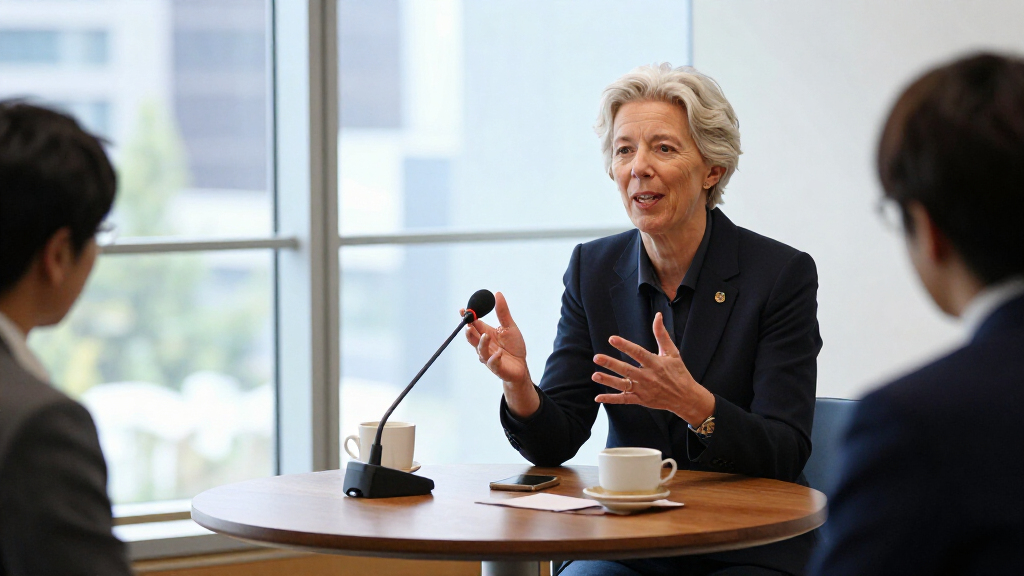
In an interview published by the European Central Bank on November 7, Christine Lagarde discussed the euro area’s October inflation reading, energy costs and the ECB’s approach to monetary policy. She said the rise was largely energy-driven, while core inflation was unchanged at 2.5%, and said the ECB was not yet seeing evidence of broader second-round effects. She did not pre-empt the next forecast or signal a specific interest-rate decision.
The European Central Bank published an interview with President Christine Lagarde on November 7, in which she said euro area headline inflation reached 4% in October, largely reflecting higher energy inflation, while the ECB was not seeing signs of second-round effects beyond those already included in its projections. Her comments to Japan’s Yomiuri Shimbun provide a snapshot of the risks the central bank is weighing, but do not announce a change in interest rates or a new inflation forecast.
Lagarde said October headline inflation was higher than the ECB had expected a few months earlier, though it was in line with market expectations. Energy inflation rose to 20.8% from 18.9% in September, which she attributed to conflict in the Middle East and reduced global refinery capacity. She also said food inflation had increased. The interview did not provide a detailed breakdown of the food price change.
Measures of underlying inflation were more stable. Core inflation, which excludes energy, food, alcohol and tobacco, stood at 2.5% in October, unchanged from September. Services inflation edged up to 3.3%, but Lagarde said it remained within the range recorded over the previous four months. She said the ECB was awaiting more detailed data to determine whether services price increases were concentrated in energy-intensive sectors such as transport or spreading more widely.
Lagarde said the bank was monitoring wage agreements and companies’ wage expectations for evidence that initial price increases were feeding into broader price and wage pressure. She said the ECB had not yet observed such a shift. She also pointed to changes since the September projections, including higher energy futures curves and long-term interest rates, while noting oil prices had recently fallen. The next forecast exercise, she said, would assess how those forces affect medium-term inflation and growth.
Energy Prices Shape ECB Risk Assessment
The interview matters because the 4% headline rate is being driven by a sharp energy increase, while core inflation is holding at 2.5%. That difference helps explain why the ECB is tracking both current price data and signs that higher costs might spread into wages and other prices. Lagarde said the longer inflation remains high, the greater the risk to the bank’s medium-term target.
Her remarks also underscore the uncertainty confronting monetary policymakers. Higher energy costs and interest rates could affect both inflation and economic growth, but the interview does not establish how the ECB will respond. Lagarde said policy decisions would be based on incoming data and made meeting by meeting; she did not commit to a rate increase or provide a new policy path.
Products Worth Considering

Logitech MX Keys S Combo Wireless Keyboard and Mouse, Graphite

Logitech MX Master 4 for Mac Wireless Ergonomic Mouse, White Silver

LG UltraGear 25G590B-B 25-Inch Full HD 1000Hz Gaming Monitor
As an affiliate, we earn on qualifying purchases.
Lessons From the 2021 Energy Shock
Asked about the ECB’s response to the 2021 energy shock following Russia’s invasion of Ukraine, Lagarde said central banks had initially judged supply-driven inflation to be temporary. She recalled discussions involving the Federal Reserve, Bank of England, Bank of Japan and ECB, where policymakers expected supply pressures to recede. In hindsight, she said, that assessment was misguided because the shock coincided with a demand surge as economies reopened and consumers spent savings accumulated during the pandemic.
That experience is relevant to the current debate because Lagarde described today’s environment as marked by trade and supply-chain disruptions, geopolitical fragmentation and a greater focus on security over efficiency. She did not say the current circumstances are identical to 2021. Instead, she framed the past episode as a reason to account for interacting forces and uncertainty rather than rely on an assumption that a price shock will quickly fade.
The interview also addressed women’s representation at the ECB. Lagarde said two women were among 27 people seated at Governing Council meetings: herself and Executive Board member Isabel Schnabel, whom she said was stepping down at the beginning of January. Lagarde attributed appointments to governments of member states and said the pool of experienced women was still building, while decision-makers may tend to choose people who resemble themselves.
“The underlying indicators are stable.”
— Christine Lagarde, ECB president, in the Yomiuri Shimbun interview
Inflation Drivers Await More Data
The interview does not establish how much of the rise in services inflation reflects energy-intensive industries, such as transport, or whether indirect price pressures are broadening. Lagarde said the detailed inflation breakdown was not yet available and that the ECB would examine it. She also said there was no evidence at that point of a shift in wage agreements or company wage expectations, but described those indicators as under close review.
It remains unclear how higher energy futures and long-term interest rates will change the ECB’s medium-term outlook. Lagarde declined to anticipate the results of the next forecast exercise, and the interview contains no new numerical projection, interest-rate decision or timetable for future rate moves. The cited figures and assessments are those discussed in the interview; later data may alter the picture.
ECB Forecasts Will Test the Outlook
The next key development is the ECB’s forecast exercise, which Lagarde said would evaluate the combined effects of energy futures, interest rates and other economic forces on inflation and growth. The bank will also assess the forthcoming detailed inflation breakdown and continue monitoring wage agreements and business expectations for second-round effects.
Lagarde described monetary policy as data-dependent and decided meeting by meeting. The interview gives no date for a particular policy change and does not promise that rates will rise or fall. The next forecast and incoming price and wage data will provide further evidence, but the ECB’s response remains unresolved.
Key Questions
What did Lagarde say about euro area inflation in October?
She said headline inflation was 4%, higher than the ECB had expected a few months earlier but in line with market expectations. Energy inflation rose to 20.8% from 18.9% in September.
Was underlying inflation also higher?
Core inflation, excluding energy, food, alcohol and tobacco, was 2.5%, unchanged from September. Services inflation edged up to 3.3%, which Lagarde said remained within the range of the previous four months.
Did Lagarde signal an interest-rate increase?
No. She did not announce or commit to a rate move. She said the ECB would assess incoming data and make monetary policy decisions meeting by meeting.
What does the ECB mean by second-round effects?
In this discussion, the term refers to initial price increases feeding into broader price and wage pressures. Lagarde said the ECB was monitoring wage agreements and company expectations but was not then seeing evidence of a shift beyond what its projections already included.
When was the interview conducted and published?
The ECB says the interview with Yomiuri Shimbun journalist Hironari Akiyama was conducted on November 4, 2026, and published on November 7.
Source: ecb.europa.eu