

Choosing between Bitcoin ETFs and direct ownership in a Crypto IRA depends on how much control, security, and flexibility you want. With an ETF, you hold shares managed by a third party, which simplifies security and tax reporting, but limits ecosystem access and transfer options. Direct ownership gives you full control over private keys, enabling you to participate in DeFi, staking, and other activities, though it requires more security vigilance. Explore further to discover detailed advantages and considerations for your investment goals.

Get smart everyday buys delivered free — and shop member deals
- Fast, free delivery on millions of items
- Access to Prime Big Deal Days deals on October 6–7
- Prime Video, Amazon Music and more included
Key Takeaways
- Direct ownership in a Crypto IRA offers control over private keys, enabling active participation in the Bitcoin network and DeFi.
- Bitcoin ETFs simplify tax reporting and custodian management but limit asset utilization and ecosystem engagement.
- ETFs trade during market hours and may trade at premiums or discounts, while direct ownership allows 24/7 trading and real-time pricing.
- Holding Bitcoin directly in a Crypto IRA enables participation in staking, lending, and other DeFi activities for potential income.
- ETFs provide a passive investment option with lower security responsibilities but restrict practical asset use and ecosystem involvement.
As an affiliate, we earn on qualifying purchases.
Ownership and Control Differences
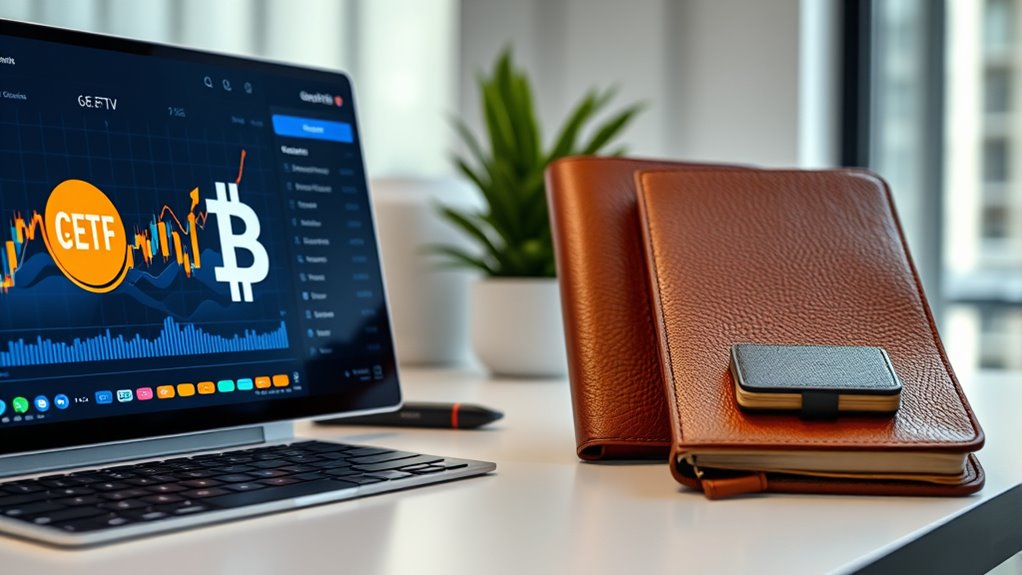
When it comes to ownership and control, the key difference is that holding Bitcoin directly in a Crypto IRA means you own the actual coins and have full authority over them. You manage your private keys or rely on a custodian to do so, giving you direct access to participate in the Bitcoin network. This setup allows you to decide when and how to trade, transfer, or utilize your Bitcoin. In contrast, Bitcoin ETFs represent shares in a fund that holds Bitcoin, not the asset itself. You don’t control the underlying coins, only the fund shares. This limits your ability to transfer or use Bitcoin directly. With direct ownership, you gain autonomy and flexibility, while ETF investors are more removed from the actual asset and its underlying technology. Additionally, private key management plays a crucial role in securing your holdings when you own Bitcoin directly.
As an affiliate, we earn on qualifying purchases.
Tax Implications and Reporting Considerations

Owning Bitcoin directly within a Crypto IRA can considerably impact your tax situation and reporting responsibilities. With direct ownership, you must track capital gains and losses on each sale or transfer, increasing reporting complexity. Your tax treatment depends on whether your IRA is traditional (tax-deferred growth) or Roth (tax-free growth). In contrast, ETFs simplify reporting—your broker handles most paperwork, but you still need to report gains outside an IRA. Here’s a visual to understand the differences:
| Aspect | Direct Ownership | ETF Investment | Reporting Complexity |
|---|---|---|---|
| Tax Treatment | Tax-deferred or tax-free within IRA | Capital gains taxed outside IRA | Higher with direct crypto sales |
| Recordkeeping | Detailed, ongoing tracking | Broker handles reporting | Lower for ETFs |
| Tax Events | Occur at sale outside IRA | Occur when selling ETF shares | Less frequent outside IRA |
Additionally, understanding the bias to action can help streamline decision-making processes when managing your crypto investments.
As an affiliate, we earn on qualifying purchases.
Trading Flexibility and Liquidity Factors

Trading flexibility and liquidity are key factors to contemplate when choosing between Bitcoin ETFs and direct ownership within a Crypto IRA. With ETFs, you’re limited to trading during regulated market hours, typically weekdays, which can restrict your ability to react instantly to market swings. Conversely, direct ownership grants you 24/7 access to buy or sell on various global exchanges, giving you greater control over timing. However, ETF shares might trade at premiums or discounts to Bitcoin’s actual value, affecting liquidity. Direct ownership allows transactions at real-time market prices, but the liquidity depends on the exchange and trading volume. Overall, if quick, round-the-clock trading aligns with your strategy, direct ownership offers more flexibility, while ETFs provide more structured, regulated trading sessions.
As an affiliate, we earn on qualifying purchases.
Cost Structures and Fee Comparisons

When comparing costs, you should consider management and expense fees that can chip away at returns over time. Custody and storage costs also play a role, especially with direct ownership requiring secure storage solutions. Additionally, transaction and trading fees vary between ETFs and direct Bitcoin holdings, affecting your overall expenses. Incorporating the wall organization in your investment setup can also help manage physical storage spaces more efficiently.
Management and Expense Fees
Management and expense fees play a crucial role in determining the overall cost-effectiveness of Bitcoin investment options within a Crypto IRA or through ETFs. With ETFs, you pay ongoing management and administrative fees, which gradually reduce your returns. These fees are built into the fund’s expense ratio, and they can range from 0.1% to over 0.75% annually. In contrast, Crypto IRAs often involve trading fees, account maintenance costs, and custody fees for secure storage. While some providers waive certain fees upfront, you should consider long-term costs. Direct ownership in a Crypto IRA can be more economical over time since you avoid management fees associated with ETFs. However, securing private keys and storage solutions may incur initial expenses, which are a one-time cost. Additionally, understanding cookie management can help you make informed decisions about online security and privacy while researching these investment options.
Custody and Storage Costs
Custody and storage costs substantially impact the overall expense of investing in Bitcoin through a Crypto IRA or an ETF. With a Crypto IRA, you’re responsible for secure custody, often through specialized providers that charge fees for cold storage, insurance, and account maintenance. These costs can add up, especially if you choose high-security options. In contrast, Bitcoin ETFs eliminate the need for individual custody; the fund handles storage, typically within regulated custodial accounts, which spreads costs across many investors. While ETF providers include custody fees in their expense ratios, you avoid direct storage expenses. Overall, direct ownership might incur higher upfront custody costs but offers greater control, while ETFs provide convenience at the expense of built-in management fees covering custody services.
Transaction and Trading Fees
Transaction and trading fees play a crucial role in determining the overall cost of investing in Bitcoin through either a Crypto IRA or an ETF. With Bitcoin ETFs, you typically pay brokerage commissions and exchange fees each time you buy or sell shares, which can add up over time. These fees are often transparent and included in your broker’s fee schedule. In contrast, direct Bitcoin ownership involves trading on cryptocurrency exchanges, where fees can vary widely—often including transaction fees, network (gas) fees, and potential wallet costs. While ETFs trade during market hours with more predictable costs, owning Bitcoin directly offers 24/7 trading, which can lead to higher fees during peak times. Additionally, the diversity of environments available for cryptocurrency trading can influence the overall costs and ease of access depending on the platform used. Overall, your cost structure depends on trading frequency, platform fees, and the type of investment.
Security Measures and Custodial Risks

Security measures and custodial risks are critical considerations when choosing between direct Bitcoin ownership in a Crypto IRA and investing through a Bitcoin ETF. With direct ownership, you control your private keys or rely on custodians, so security depends on your practices or the custodian’s safeguards. This exposes you to risks like private key loss, hacking, or theft if proper security isn’t maintained. In contrast, Bitcoin ETFs are regulated products with built-in protections, reducing your direct security responsibilities. However, they depend on fund managers and custodians, which introduces third-party risks such as mismanagement or insolvency. Overall, direct ownership offers blockchain-based security but demands diligence, while ETFs offer legal protections but rely on institutional custodianship, each with its unique custodial risks. Additionally, understanding the Ultimate Tights Guide for Every Style and Need can provide insights into choosing secure and reliable products in various contexts.
Practical Use and Ecosystem Participation

When you own Bitcoin directly, you can actively participate in DeFi applications, staking, and lending, expanding your involvement in the crypto ecosystem. In contrast, Bitcoin ETFs limit you to trading shares, offering no access to these practical uses. Your level of engagement depends on whether you want to utilize your assets beyond speculation or prefer a more passive investment. Additionally, owning Bitcoin directly allows for Hyundai Tuning modifications and upgrades, giving you more control over your asset’s performance and customization options.
Direct Asset Utilization
Owning Bitcoin directly within a Crypto IRA opens up a wide range of practical uses and ecosystem participation that ETFs simply can’t provide. With direct ownership, you can actively use your Bitcoin for decentralized finance (DeFi) applications like staking, lending, or yield farming, which can generate additional income and enhance your investment’s utility. You also have the ability to participate in token swaps, participate in blockchain governance, or even transfer assets across different platforms. This hands-on approach allows you to leverage your Bitcoin beyond mere speculation, engaging meaningfully with the crypto economy. In contrast, ETFs limit you to trading shares, restricting any direct interaction with the underlying blockchain or ecosystem activities. Direct ownership empowers you to maximize your assets’ functional potential.
Ecosystem Engagement Opportunities
Ecosystem engagement opportunities are substantially greater with direct Bitcoin ownership, giving you the ability to actively participate in the broader crypto economy. When you hold actual Bitcoin, you can tap into decentralized finance (DeFi), stake your assets, lend to earn interest, or use them in various blockchain applications. This hands-on involvement amplifies your influence and control within the ecosystem. Additionally, engaging directly with Bitcoin allows you to explore a variety of knitting patterns for sweaters, which showcase the diversity and customization options available in the crypto space.
- Participate directly in DeFi projects, earning yields and leveraging assets
- Utilize your Bitcoin for staking, enhancing network security and earning rewards
- Engage in peer-to-peer transactions and innovative crypto services without intermediaries
Owning Bitcoin allows you to fully immerse yourself in the evolving crypto landscape, transforming your investment into a practical tool for financial growth and ecosystem participation.
Frequently Asked Questions
Can I Convert My Bitcoin ETF Holdings Into a Crypto IRA?
You can’t directly convert your Bitcoin ETF holdings into a Crypto IRA. To do so, you’ll need to sell your ETF shares, then transfer the proceeds into a Crypto IRA that allows for Bitcoin investments. Once the funds are in the IRA, you can purchase actual Bitcoin or other digital assets through a qualified custodian. This process involves selling, transferring, and repurchasing within the IRA framework.
How Does Inheritance Work With Direct Bitcoin Ownership Versus Bitcoin ETFS?
Imagine inheriting a Bitcoin stash in your IRA; with direct ownership, you’ll need to transfer the private keys to your designated beneficiary, ensuring they can access and control the assets securely. If it’s through a Bitcoin ETF, the process involves inheriting shares of the fund, which might require contacting the brokerage to transfer ownership. Direct ownership offers more control, but ETFs simplify paperwork and estate handling.
Are There Regulatory Restrictions on Transferring Bitcoin From a Crypto IRA?
Yes, there are regulatory restrictions when transferring Bitcoin from a Crypto IRA. You can’t simply move the assets freely; the transfer must comply with IRA rules and custodial procedures. You’ll need to work through your IRA custodian, who ensures the transfer aligns with tax laws and regulations. Unauthorized or improper transfers could trigger penalties or taxable events, so always consult your custodian or a financial advisor before initiating any transfer.
What Happens if a Custodian or Fund Provider Goes Bankrupt?
If a custodian or fund provider goes bankrupt, your crypto assets are still protected, but the process can get complicated. You might need to transfer your holdings to another custodian or liquidate your position, depending on the situation. It’s essential to review the provider’s bankruptcy policies and guarantee your assets are segregated and insured. Staying informed and choosing reputable providers reduces your risk of losing access or assets during insolvency.
Is It Possible to Switch Between ETF Investment and Direct Ownership Easily?
Switching between ETF investment and direct ownership is like changing gears in a car—you can do it, but it takes some effort. You’ll need to sell your ETF shares through your broker, then transfer or purchase Bitcoin directly within your IRA or outside it. The process involves paperwork, potential tax implications, and waiting periods. While it’s possible, it’s not always quick or seamless, so plan accordingly for a smooth shift.
Conclusion
Just like the fabled coins of old, your choice between Bitcoin ETFs and direct crypto in a IRA shapes your financial legend. With ETFs, you ride the wave of flexibility and simplicity, while direct ownership offers hands-on control and deeper ecosystem ties. As you weigh security and costs, remember that your decision writes your own story—one of strategy, risk, and potential—guiding your voyage through the vast digital gold rush, where every move echoes through your financial future.
Fall Picks
fall essentials
As an affiliate, we earn on qualifying purchases.