

If you’re comparing Ethereum, Solana, and Cardano’s proof-of-stake systems, you’ll find notable differences. Ethereum uses Casper-FFG with high security and finality by locking 32 ETH; Solana combines PoS with Proof-of-History for fast, high-throughput validation but faces some outage risks; Cardano employs Ouroboros for secure, epoch-based finality that balances speed and decentralization. Each design offers unique tradeoffs, and exploring further will reveal how these choices impact network security, speed, and participation.
Key Takeaways
- Ethereum uses Casper-FFG, requiring validators to stake 32 ETH with finality achieved through two-thirds consensus, emphasizing security and irreversibility.
- Solana combines PoS with Proof-of-History, enabling fast block times (~400ms) and high throughput but with fewer validators and occasional network outages.
- Cardano employs Ouroboros, utilizing epochs and probabilistic finality, balancing security with scalability through cryptographic randomness and delegation.
- Ethereum prioritizes decentralization with thousands of validators and staking pools; Solana favors speed with fewer validators; Cardano aims for broad decentralization with many stake pools.
- All three networks implement slashing penalties to deter malicious behavior, but their consensus models differ in speed, finality, and security guarantees.
Core Principles of Ethereum’s Proof-of-Stake System

Ethereum’s Proof-of-Stake (PoS) system is built on the principle of secure, energy-efficient consensus through staking. You participate by locking up 32 ETH as collateral, becoming a validator responsible for proposing and attesting to new blocks. Finality is achieved with Casper-FFG, where two-thirds of the stake must agree before a block becomes irreversible. This economic model discourages malicious behavior, as penalties like slashing can be applied for misbehavior or downtime. Your chances of being selected as a validator depend on how much ETH you stake and how long you’ve staked it, incentivizing long-term commitment. To include smaller holders, staking pools allow you to combine resources, earn rewards, and trade proxy tokens representing your staked ETH. Forsale 100
Unique Features of Solana’s Consensus and Validation Approach

Solana’s consensus and validation approach stands out due to its innovative combination of Proof-of-Stake (PoS) with the Proof-of-History (PoH) mechanism. PoH creates a cryptographic timestamp sequence that orders transactions, enabling faster validation by reducing communication overhead among validators. This hybrid design allows validators to quickly verify transaction history before proposing new blocks, markedly boosting throughput. You’ll notice that Solana’s architecture emphasizes speed, with block times around 400 milliseconds and the capacity to process thousands of transactions per second. Validators stake SOL tokens to participate, and those with higher stakes have greater chances of being selected for consensus. While this approach achieves impressive scalability, it also introduces tradeoffs, such as increased network complexity and challenges in maintaining decentralization at scale. Additionally, Solana’s architecture relies heavily on network security mechanisms to prevent potential vulnerabilities.
Cardano’s Ouroboros Protocol and Its Security Guarantees
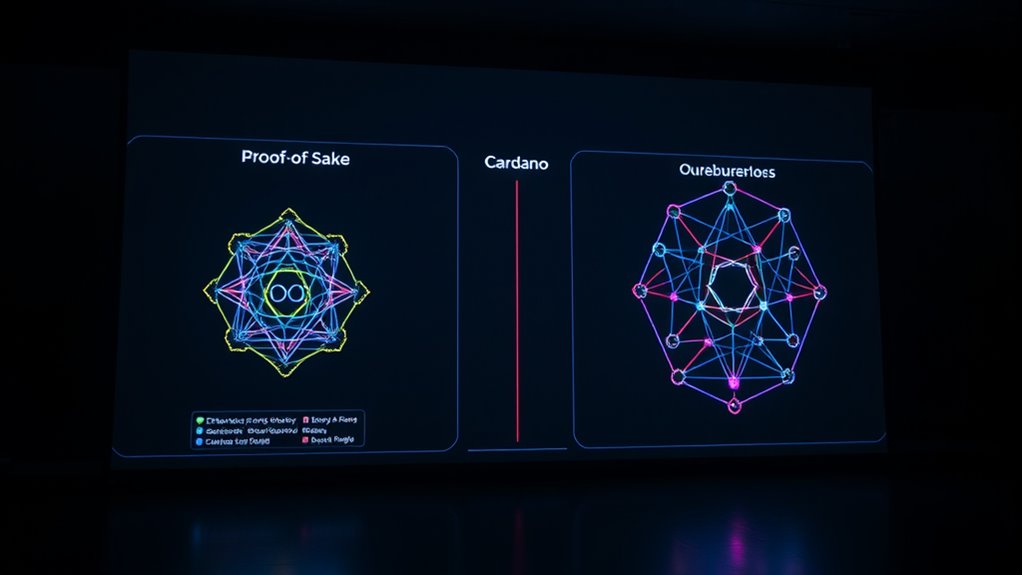
Cardano’s Ouroboros protocol achieves security through a rigorous proof-of-stake mechanism that divides time into epochs and slots, with each slot designated for a specific slot leader to produce blocks. You can trust this system because it’s mathematically proven to be secure, even against adversaries controlling up to 50% of the stake. The protocol relies on cryptographic randomness to select slot leaders, ensuring fair and decentralized participation. Finality is probabilistic but highly reliable, with the security guarantees increasing as more blocks confirm over time. If malicious validators act, they risk losing their stake through slashing, which deters misbehavior. Overall, Ouroboros balances energy efficiency, decentralization, and strong security, making Cardano’s network resilient against attacks. Additionally, the use of cryptographic techniques in Ouroboros enhances the protocol’s soundness and robustness.
Minimum Stake Requirements and Validator Roles Across Networks

Minimum stake requirements and validator roles vary considerably across proof-of-stake networks, shaping who can participate and how. On Ethereum, you need to stake 32 ETH to become a validator, proposing and attesting to blocks. Smaller holders often join staking pools to meet this threshold. Solana’s requirements are more flexible; validators stake SOL tokens, with minimums that can be lower or vary, and they validate and produce blocks using a hybrid consensus. Cardano has no strict minimum for individual stakers because ADA can be delegated to stake pools, which handle block production. Validator roles differ slightly: Ethereum validators propose and finalize blocks, Solana validators produce and validate, and Cardano’s slot leaders produce blocks based on stake. These protocols influence participation, decentralization, and security. Additionally, staking participation is impacted by the specific minimum requirements and validator roles within each network.
Incentive Structures and Reward Distribution Mechanisms

Incentive structures and reward distribution mechanisms are central to motivating validators and maintaining network security across proof-of-stake blockchains. On Ethereum, validators earn rewards proportional to their staked ETH, with frequent distributions based on network activity and pool performance. Rewards incentivize honest participation and long-term commitment, while penalties like slashing discourage malicious behavior. Solana offers rewards based on SOL stakes, with high-stakes validators receiving larger rewards, encouraging reliability. Its fast rewards cycle pushes validators to stay active and dependable. Cardano distributes rewards periodically, reflecting each stake’s size and pool efficiency, promoting decentralization. Delegation allows ADA holders to earn rewards without running a validator. Across all three, these mechanisms align validator incentives with network health, balancing growth, security, and decentralization. Additionally, understanding the Gold IRA Rollovers process can help diversify an investor’s portfolio for long-term financial security.
Security Measures and Finality Models in Each Blockchain

You should consider how each blockchain guarantees security and finality to protect against attacks and faults. Their approaches involve different finality guarantees, slashing penalties, and resilience measures that maintain network integrity. Understanding these mechanisms helps you evaluate their robustness and suitability for various use cases. For example, the finality models employed by each platform directly impact their ability to prevent rollback attacks and ensure transaction confirmation certainty.
Finality Approaches and Guarantees
How do different proof-of-stake blockchains guarantee finality and security? Ethereum uses Casper-FFG, requiring two-thirds consensus to finalize blocks, making reversals economically unfeasible and ensuring strong finality. Solana combines proof-of-stake with proof-of-history, offering rapid finality within approximately 400 milliseconds, but occasional network outages highlight challenges in maintaining continuous security at high speeds. Cardano employs Ouroboros, providing probabilistic finality through mathematically proven protocols, where finality increases with time as epochs progress, balancing security and scalability. Each network’s approach aligns with its design goals: Ethereum emphasizes irreversible finality, Solana prioritizes speed, and Cardano focuses on security via gradual, mathematically backed finality. These models shape how each blockchain guarantees its security and trustworthiness over time. Additionally, emotional support can be crucial for developers and users navigating these complex security models, as understanding and trusting the system can impact overall confidence and resilience.
Slashing and Penalties
Slashing and penalties serve as crucial security mechanisms in proof-of-stake blockchains, deterring malicious behavior and ensuring network integrity. In Ethereum, validators risk losing a portion of their staked ETH if they propose invalid blocks or go offline, with slashing penalties designed to prevent double voting and equivocation. Solana enforces penalties through slashing for validators acting maliciously or failing to validate correctly, incentivizing reliability and honesty. Cardano applies slashing for misbehavior, such as double signing or pool saturation, to protect network security. These penalties make malicious actions costly, encouraging validators to act honestly. They also help maintain finality and network stability by reducing the risk of attacks and ensuring validators follow protocol rules. Additionally, staking security mechanisms like slashing are vital for maintaining trust in proof-of-stake networks.
Network Resilience Measures
Network resilience in proof-of-stake blockchains hinges on robust security measures and reliable finality models that safeguard against attacks and ensure consistent consensus. Ethereum uses Casper-FFG, which finalizes blocks through two-thirds voting, making reversals economically prohibitive and discouraging malicious behavior. Solana combines PoS with Proof-of-History, enabling fast finality—typically within a few hundred milliseconds—though occasional outages reveal vulnerabilities. Cardano’s Ouroboros protocol offers mathematically proven security with probabilistic finality, gradually confirming blocks over epochs. All three networks implement slashing to penalize misbehavior, reinforcing security. Ethereum’s inactivity leak prevents stalling, while Cardano promotes decentralization by allowing stake delegation, reducing attack surfaces. These measures collectively enhance resilience, balancing security, speed, and decentralization. Additionally, the consensus mechanisms employed by each blockchain are designed to adapt to network conditions and maintain robustness under varying loads.
Impact on Network Decentralization and Accessibility
Proof-of-stake mechanisms substantially influence the decentralization and accessibility of blockchain networks. With Ethereum, staking 32 ETH creates high entry barriers, but staking pools help smaller holders participate, broadening access. Solana’s lower minimum stakes and fast transaction speeds attract a wider user base, though its rapid validation sometimes favors larger validators, risking centralization. Cardano’s delegation system allows ADA holders to participate without large capital investments, enhancing decentralization. However, the network’s reliance on stake pools can concentrate control if a few pools dominate. Overall, each network’s design impacts how evenly power and participation are distributed. While PoS lowers entry barriers compared to PoW, actual decentralization depends on staking requirements, pooling options, and network governance, shaping how accessible and resilient these networks remain. Additionally, the distribution of staking power within each network plays a crucial role in maintaining a truly decentralized system.
Energy Consumption and Scalability Strategies

You need to understand how different proof-of-stake networks reduce energy consumption through their unique approaches, like Ethereum’s move away from energy-intensive mining. Scalability strategies, such as Solana’s high-throughput architecture and Cardano’s epoch-based system, also play a key role in handling increasing transaction loads efficiently. Exploring these techniques reveals how networks balance sustainability with performance to support widespread adoption.
Energy Efficiency Approaches
Energy efficiency and scalability are central concerns for blockchain platforms adopting Proof-of-Stake mechanisms. You’ll notice Ethereum reduces energy use compared to its previous Proof-of-Work system by requiring validators to stake ETH rather than perform energy-intensive mining. This shift makes Ethereum more sustainable without sacrificing security. Solana’s approach emphasizes high throughput and low latency, combining PoS with its Proof-of-History system to process thousands of transactions per second while keeping energy consumption minimal. Cardano balances security and efficiency through its Ouroboros protocol, which uses epoch-based consensus to optimize resource use. All three networks prioritize lower energy costs by moving away from energy-intensive mining, but they also implement different scalability strategies—layered architectures, hybrid consensus models, and delegation—to support growth without increasing energy demands considerably.
Scalability Techniques
How do blockchain networks scale efficiently without sacrificing decentralization or increasing energy consumption? You achieve this by implementing innovative techniques that balance speed, security, and energy use. Here are four key strategies:
- Layered Architecture – Ethereum separates execution from consensus, allowing parallel processing and improved scalability.
- High-Throughput Protocols – Solana uses Proof-of-History to timestamp transactions, enabling thousands of transactions per second.
- Epoch-Based Validation – Cardano divides time into epochs and slots, optimizing transaction flow while maintaining security.
- Delegated Staking & Pooling – All networks promote stake delegation and pooling, increasing decentralization without overburdening individual validators.
These strategies enable networks to grow, process more transactions, and stay energy-efficient simultaneously.
Validator Penalties and Slashing Conditions
What happens when validators behave maliciously or fail to stay online in proof-of-stake networks? You face penalties designed to keep the network secure and honest. Ethereum slashes validators who propose invalid blocks or go offline repeatedly, losing part of their staked ETH—sometimes up to the entire deposit. Solana also slashes validators for malicious actions or prolonged downtime, reducing their stake and earning potential. Cardano employs a different approach, penalizing pools that misbehave or become saturated, which can lead to reduced rewards or disqualification. These slashing conditions act as strong deterrents against bad behavior, ensuring validators remain committed and trustworthy. Penalties reinforce network integrity, discourage malicious activities, and maintain overall security for all participants.
Tradeoffs Between Speed, Security, and Decentralization

You’ll find that increasing transaction speed often means sacrificing some security or decentralization. Balancing validator incentives is key, as rewarding reliability can lead to centralization, but neglecting it risks network integrity. Ultimately, choosing the right tradeoff depends on your priorities for security, speed, and a decentralized network.
Transaction Speed vs. Security
Balancing transaction speed, security, and decentralization involves maneuvering inherent tradeoffs in proof-of-stake networks. Faster networks often sacrifice some security or decentralization to achieve rapid confirmation times. For example:
- Ethereum offers solid security with Casper-FFG but has moderate speed, balancing safety and performance.
- Solana prioritizes speed with sub-second confirmations, which can increase risks during network outages or attacks.
- Cardano emphasizes security through mathematically proven protocols, resulting in slightly slower transaction times.
- Tradeoffs mean that networks optimizing for speed might face increased vulnerability, while those prioritizing security may process transactions more slowly. You must decide which aspect weighs more based on your priorities and use case.
Decentralization vs. Scalability
Decentralization and scalability often pull networks in opposite directions, creating inherent tradeoffs that impact their overall performance and security. Higher decentralization means more validators, which can slow down transaction speeds and increase complexity. Conversely, focusing on scalability may lead to fewer validators or larger pools, risking centralization. Here’s a quick comparison:
| Feature | Ethereum | Solana | Cardano |
|---|---|---|---|
| Validator count | Thousands | Hundreds | Thousands |
| Stake distribution | Wide, decentralized | Concentrated among pools | Broad, delegated pools |
| Speed vs. decentralization | Moderate | Very fast, less decentralized | Balanced |
| Security level | High (finality) | High, but outages | High, mathematically proven |
| Network resilience | Robust | Faster, but occasional outages | Secure, scalable |
You face a constant balancing act: prioritize speed or uphold decentralization.
Validator Incentives Balance
Validator incentives in proof-of-stake networks are carefully designed to encourage participation while balancing speed, security, and decentralization. You need to understand that each network’s approach impacts these tradeoffs differently.
- Ethereum offers high rewards for long-term staking, encouraging security but requiring large stakes (32 ETH), which can centralize influence.
- Solana emphasizes fast validation and throughput, rewarding reliable validators but risking centralization due to high hardware requirements.
- Cardano promotes decentralization through delegation, rewarding pools based on performance, balancing security with accessibility.
- All three networks penalize malicious or offline validators, but speed-focused systems like Solana may sacrifice some security guarantees for rapid finality.
This balance influences how inclusive, safe, and efficient the network remains.
Frequently Asked Questions
How Do Staking Pools Affect Decentralization in Each Network?
Staking pools boost decentralization by allowing you to delegate your stake without running a validator yourself, which spreads control across many participants. On Ethereum and Cardano, pools enable smaller holders to participate actively, reducing centralization risks. Solana’s pools also promote decentralization, but high staking thresholds can concentrate stakes among large pools. Overall, pools democratize staking, giving more people a voice in network security and decision-making processes.
What Are the Long-Term Economic Incentives for Validators?
Think of the network as a garden, where validators are the diligent gardeners. Your long-term economic incentives include earning rewards proportional to your stake, encouraging you to stay committed and honest. These rewards grow as you contribute over time, and penalties for misbehavior act like weeds that threaten your gains. By staking consistently, you cultivate trust, ensuring your efforts pay off and help sustain the network’s health and security.
How Do Finality Times Compare Across Ethereum, Solana, and Cardano?
You’ll find that Solana offers the fastest finality, often within 400 milliseconds, making transactions nearly instant. Ethereum’s finality depends on the Casper-FFG mechanism and usually takes a few seconds to minutes, depending on network conditions. Cardano provides probabilistic finality, with blocks confirmed over several epochs, which can take minutes to hours for absolute finality. Your choice depends on your need for speed versus security and decentralization.
What Are the Specific Slashing Conditions for Misbehavior?
Think of slashing as a sharp sword cutting through bad behavior. You get penalized if you double-sign blocks, go offline, or try to manipulate the network. In Ethereum, misbehavior leads to losing staked ETH, sometimes a third of it. Solana slashes for malicious activity or downtime, while Cardano penalizes poor pool performance or saturation. These rules keep your stake honest and the network safe from troublemakers.
How Does Network Scalability Impact Security and Decentralization Balance?
You should understand that increased network scalability often involves trade-offs with security and decentralization. As you scale up, the network might become more centralized if fewer validators control most of the stake, risking security. Conversely, aiming for decentralization can limit scalability because it requires more validators, which can slow down transactions. Balancing these factors is vital; optimizing one often requires compromises in the others to maintain a secure, decentralized, and scalable network.
Conclusion
You now see how Ethereum, Solana, and Cardano each prioritize different aspects of proof-of-stake. For example, Solana can process over 65,000 transactions per second, highlighting its focus on scalability. While Ethereum emphasizes decentralization, Solana leans toward speed, and Cardano balances security with sustainability. Understanding these tradeoffs helps you appreciate how each network aims to shape the future of blockchain technology based on your priorities.