
TL;DR

Get smart everyday buys delivered free with Prime
- Fast, free delivery on millions of items
- Prime Video, Amazon Music and more included
- Member-only deals all year
Thorsten Meyer AI has published a 2026 cooling guide for always-on AI inference workstations that favors large air coolers for most builds. The report says liquid AIOs still make sense for very hot CPUs, tight cases, or warm rooms, but add pump-related failure risk and higher lifetime cost.
Thorsten Meyer AI has published a 2026 guide that makes air cooling the default recommendation for most 24/7 AI inference rigs, arguing that long-term reliability matters more than peak benchmark temperatures for workstations expected to run for hours or days without close supervision.
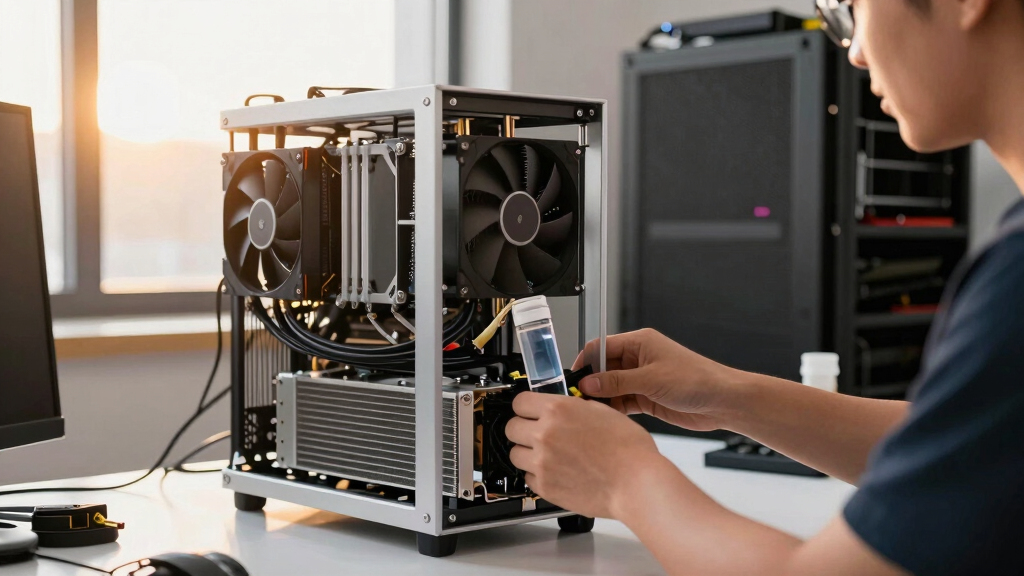
The guide says gaming PC cooler comparisons often focus on peak temperatures, while always-on inference machines face a different test: whether the cooling system can keep working over years of sustained use. Its central finding is that a large dual-tower air cooler is the safer choice for most systems because it has fewer failure points and simpler maintenance.
According to Thorsten Meyer AI, an air cooler’s main moving part is the fan, which can usually be replaced quickly and cheaply. By contrast, the guide says a sealed all-in-one liquid cooler includes a pump that acts as a single point of failure. It describes many AIO units as non-refillable and non-repairable, meaning a pump failure often requires replacing the whole cooler.
The guide does not dismiss liquid cooling. It says a 360mm AIO can be the right choice when a CPU is too hot for air cooling under sustained all-core load, when a large tower cooler will not physically fit, or when the system needs to move heat out through a radiator instead of dumping it into a cramped or warm case.
Why It Matters
The recommendation matters because local AI workstations are increasingly being used as long-running inference machines rather than short-burst gaming PCs. For users running models overnight or across multi-day jobs, a cooling failure can mean downtime, throttling, failed workloads, or hardware stress.
The guide also frames the choice as a cost and maintenance issue. It says liquid AIOs can cost two to three times more over their life once replacement is factored in, while high-end air coolers may last across multiple builds if mounting support remains available. That makes the cooling category decision part of total ownership cost, not just a temperature chart comparison.
As an affiliate, we earn on qualifying purchases.
Background
The article is presented as part of Thorsten Meyer AI’s workstation cooling coverage and is tied to its broader guide on reducing heat and noise in high-power AI workstations. The new comparison focuses on the category choice between air and liquid cooling rather than naming specific cooler models.
The guide cites typical 2026 figures, saying high-end air coolers can handle around 250 watts of sustained CPU heat in many builds, while 360mm AIO liquid coolers can provide roughly 360 watts of sustained headroom for the hottest CPUs, heavy all-core loads, or overclocked systems. It attributes the broader performance ranges to 2026 cooling comparisons from outlets and vendors including Tom’s Hardware, Corsair, MSI, and independent reviewers.
Thorsten Meyer AI also includes an affiliate disclosure, saying the article contains affiliate links and that prices and availability change often. Readers are told to check current pricing and hardware compatibility before buying.
“For set-and-forget systems, air remains the safest choice.”
— Thorsten Meyer AI guide
“An air cooler has one moving part. An AIO has a pump on a clock.”
— Thorsten Meyer AI guide
“Outside those cases, the pump is complexity you’re paying for and don’t need.”
— Thorsten Meyer AI guide
As an affiliate, we earn on qualifying purchases.
What Remains Unclear
The guide’s figures are presented as typical ranges, not guarantees. Actual results can vary by CPU model, power limit, case airflow, radiator placement, fan curve, ambient temperature, mounting quality, and dust buildup. It is also unclear how any one AIO pump will age in a specific 24/7 environment, since wear depends on unit design and operating conditions.
high reliability CPU cooling fan
As an affiliate, we earn on qualifying purchases.
As an affiliate, we earn on qualifying purchases.
What’s Next
For readers building or updating an inference rig, the next step is to check three constraints before buying: whether a large dual-tower air cooler fits the case, whether the CPU will run sustained all-core loads beyond what air can handle, and whether the room or case layout requires heat to be pushed out through a radiator. Current prices, socket support, RAM clearance, and case measurements should be verified before purchase.
long-lasting AI inference workstation cooling
As an affiliate, we earn on qualifying purchases.
As an affiliate, we earn on qualifying purchases.
Key Questions
Is air cooling now the recommended default for 24/7 inference rigs?
According to Thorsten Meyer AI, yes, for most builds. The guide says air cooling is simpler, cheaper over time, quieter at the low end, and has fewer parts that can fail.
When does a 360mm AIO liquid cooler make sense?
The guide points to three main cases: a very hot CPU under sustained all-core load, a compact or multi-GPU case that cannot fit a large air tower, or a warm room where moving heat out through a radiator is useful.
Are liquid coolers unsafe for AI workstations?
The source does not say that. It says liquid AIOs can offer more thermal headroom, but they add a pump, sealed-loop wear, higher lifetime cost, and replacement risk that may not be needed in many 24/7 rigs.
What remains uncertain before choosing a cooler?
Specific performance depends on the full build. CPU power draw, airflow, room temperature, case clearance, radiator placement, fan curves, and the cooler model can change the result.
Source: Thorsten Meyer AI
Halloween Picks
halloween
As an affiliate, we earn on qualifying purchases.