TL;DR

Get smart everyday buys delivered free with Prime
- Fast, free delivery on millions of items
- Prime Video, Amazon Music and more included
- Member-only deals all year
Thorsten Meyer AI closed its Built in Public series by naming the Local-First Agentic Operator, a thesis tying 18 products into one operating model. The confirmed development is the publication of the finale and its four-part framing; the broader claim that one person can build and run a broad software portfolio with agentic AI remains Meyer’s interpretation.
Thorsten Meyer AI has closed its Built in Public series by naming The Local-First Agentic Operator, framing 18 products across seven product families as one operating model rather than a collection of unrelated launches. The publication matters because it puts a clear thesis around a growing claim in AI software work: that a single human operator, assisted by agentic AI, can build and manage a software portfolio that once implied a larger organization.
The finale says the 18 products span content, decision, platform, open-and-regulated, markets, defense-and-intel, and diagnostic tools. Examples cited in the source material include a WordPress content engine, a news-as-geography globe, a regulated-QA system for life sciences, a prediction-market bot, trading agents, an OSINT analyzer, and satellite-radar ISR tools.
The confirmed point is the portfolio framing. Meyer lists four facets: local-first systems that keep compute and data under the operator’s control; provider-agnostic model layers; products built by a non-developer with agentic AI; and editing by subtraction, or cutting outputs and actions instead of adding more activity.
The source material describes the piece as a personal working philosophy and independent commentary produced with AI assistance under human editorial oversight. It also says the views may change and that the piece is not business, financial, legal, or technical advice.
The Local-First Agentic Operator
Eighteen products that looked like a sprawl were never eighteen things. They were one thing, built eighteen times. This is the thesis underneath all of them — named.
- Not “solo beats funded team.” Depth still wins most single contests. The narrower, truer claim: the floor moved — one person can now do what recently took many.
- Breadth is strength and risk. Eighteen products is resilience and a focus problem; several are seeds, not trees.
- The AI part is assisted, not autonomous. Strip away human judgment and subtraction and you get faster mediocrity, not a portfolio.
- A pattern, not a prescription. This fit one operator, one skill set, one moment. The honest version of any manifesto includes “this worked for me.”
A synthesis and a statement of one operator’s working philosophy — independent commentary, produced with AI assistance under human editorial oversight. The views are the author’s own and may change. This is not business, financial, legal, or technical advice, and the four-facet framing is a personal operating pattern, not a prescription or a claim of results. Individual products carry their own terms, disclaimers, and limitations in their respective articles; several are early- or positioning-stage. Product, model, and company names are trademarks of their respective owners; mention does not imply endorsement.
A One-Person Software Unit
The announcement gives language to a shift many builders are testing: software production may be moving from team-led roadmaps toward smaller portfolios run by one person using AI agents. Meyer does not claim that solo work beats funded teams at depth. The narrower claim is that the minimum scale for producing and operating several products has fallen.
For readers following AI tooling, the local-first and provider-agnostic parts are the most practical elements. They point to a model of software operations that tries to reduce dependency on a single vendor’s servers or models. That matters for builders handling sensitive data, firms worried about vendor lock-in, and operators who expect model quality and pricing to keep changing.
The piece also argues that when creation becomes cheaper, judgment moves up in value. In Meyer’s framing, the human role is not just prompting systems to create more output; it is deciding what should not be built, published, traded, or trusted.
As an affiliate, we earn on qualifying purchases.
The Portfolio Behind the Thesis
The finale follows 18 product posts in a 19-day Built in Public sequence. Thorsten Meyer AI describes the set as seven families: content, decision, platform, open-and-regulated, markets, defense-and-intel, and diagnostic.
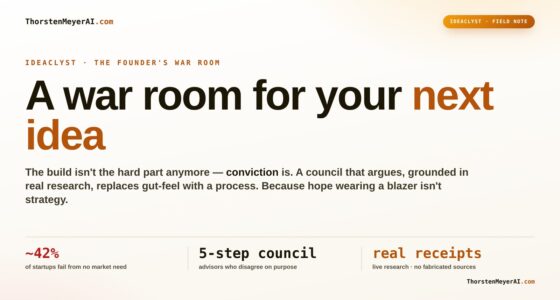
The series included tools named DojoClaw, RoundupForge, Stenvrik, ChannelHelm, IdeaNavigator, IdeaClyst, Threlmark, Outcome-First Platform, Grimfaste, Delvasta, Glasspane, QAtrial, Polybot, TradingAgents, Argus, VigilSAR, VigilSAR-Bench, and World Model Readiness. The finale says the shared foundation is more important than any single product.
The source says several projects are early or positioning-stage. It also says individual products have their own terms, disclaimers, and limits.
“These were never eighteen things. They were one thing, built eighteen times.”
— Thorsten Meyer AI
self-hostable AI content management tools
As an affiliate, we earn on qualifying purchases.
As an affiliate, we earn on qualifying purchases.
Limits Around the Operator Model
Several parts of the thesis remain claims by Meyer rather than independently verified outcomes. The source material does not provide usage numbers, revenue, customer adoption, technical benchmarks for most products, or outside audits of the portfolio’s performance.
It is also not clear how much time, outside help, infrastructure cost, or maintenance work each product required. The finale says the AI work was assisted, not autonomous, but it does not quantify the human review workload behind the 18-product series.
The largest open question is durability. A broad portfolio can reduce reliance on one product, but it can also stretch focus. Meyer acknowledges that breadth is both strength and risk.
provider-agnostic AI model platform
As an affiliate, we earn on qualifying purchases.
As an affiliate, we earn on qualifying purchases.
Proof Shifts to Execution
The next test is whether the operator model can move from published portfolio thesis to sustained product use. That means watching which of the 18 projects mature, which remain experiments, and which are cut under Meyer’s own subtraction principle.
Readers should expect any stronger claim about the model to depend on evidence beyond the finale, such as users, repeatable workflows, support patterns, public demos, case studies, or measurable results. For products touching markets, regulated QA, defense intelligence, or sensitive data, independent validation and clear limits will carry extra weight.
As an affiliate, we earn on qualifying purchases.
Key Questions
What is the Local-First Agentic Operator?
It is Meyer’s name for a working model built around local-first infrastructure, provider-agnostic AI systems, agent-assisted building by a non-developer, and editing by subtraction.
Was a new product launched?
The source material presents a synthesis and announcement, not a single new product launch. It names the thesis behind 18 products already described in the Built in Public series.
What is confirmed right now?
Confirmed details include the publication of the Day 19 finale, the 18-product portfolio framing, the seven product families, and the four stated facets of the thesis.
What remains unproven?
The source does not verify customer adoption, revenue, operating costs, independent benchmarks, or long-term durability of the operator model.
Is this financial or technical advice?
No. The source material says the framing is personal commentary and is not business, financial, legal, or technical advice.
Source: Thorsten Meyer AI
Halloween Picks
halloween
As an affiliate, we earn on qualifying purchases.