
TL;DR
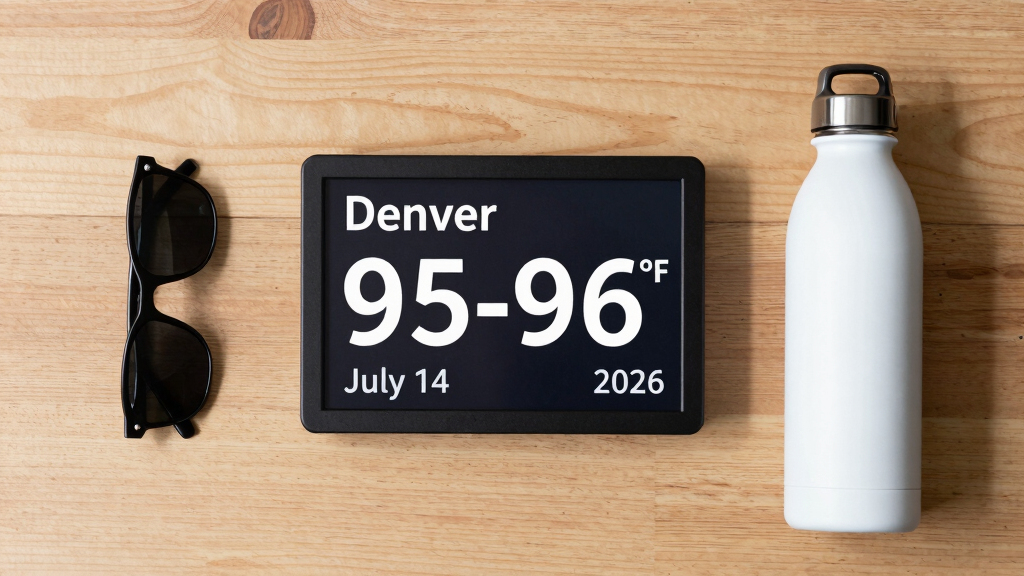
A trading market indicates a potential high in Denver of 95-96°F on July 14, 2026, but official weather forecasts are not yet available. The prediction reflects market speculation, not confirmed meteorological data.
Market activity indicates a possible high temperature of 95-96°F in Denver on July 14, 2026, but no official meteorological forecast has confirmed this prediction. This speculation stems from recent trades on a temperature prediction market, reflecting traders’ expectations rather than confirmed weather data.

Get smart everyday buys delivered free with Prime
- Fast, free delivery on millions of items
- Prime Video, Amazon Music and more included
- Member-only deals all year
Recent trades on a temperature prediction market show traders betting that Denver’s high temperature on July 14, 2026, will fall within the 95-96°F range. These trades have increased in number, suggesting some market participants see this as a likely outcome. However, official weather forecasts from meteorological agencies, which rely on climate models and current atmospheric data, have not yet provided any specific temperature predictions for that date.
Weather forecasts for July 2026 are not available at this time, as they are typically issued only a few days in advance. Experts emphasize that market-based predictions are speculative and should not be considered definitive weather forecasts. The trades are being closely watched as an indicator of market sentiment, not as an authoritative forecast.
Implications of Market-Based Temperature Predictions
The market activity around Denver’s temperature prediction highlights how financial markets are increasingly used to gauge expectations about future weather conditions. While these predictions are not official, they can influence sectors such as agriculture, event planning, and energy management, which are sensitive to temperature fluctuations. Understanding the difference between market speculation and scientific forecasts is crucial for interpreting these signals.
Products Worth Considering

LG 27G810A-B 27-inch UltraGear 4K UHD IPS Gaming Monitor

LG 27GS60QC-B Ultragear 27-inch Curved Gaming Monitor (QHD, 180Hz, 1ms, 1000R)

LG UltraGear 27-inch QHD OLED Gaming Monitor, 240Hz, 0.03ms, G-SYNC Compatible, FreeSync Premium Pro, HDR True Black 400
As an affiliate, we earn on qualifying purchases.
How Market Predictions Reflect Broader Climate Expectations
Prediction markets for weather conditions have grown in popularity, allowing traders to speculate on future temperatures and other climate variables. The recent trades indicating a high of 95-96°F in Denver on July 14, 2026, are part of this trend. Historically, such markets have been used for short-term forecasts, but their reliability for long-term predictions remains limited. Official climate models, which incorporate current atmospheric data and climate trends, do not yet provide specific forecasts for that date, emphasizing the speculative nature of market-based predictions.
“Market-based predictions can offer interesting insights into collective expectations but should never replace official weather forecasts, especially for long-range dates.”
— Dr. Emily Carter, Climate Scientist
Reliability of Market Predictions for Long-Term Weather
It is not yet clear how accurate or reliable these market-based predictions will be for long-term weather forecasting. Official forecasts for July 14, 2026, are not available, and climate models typically do not project specific daily temperatures this far in advance. The trades reflect trader expectations, which can be influenced by various factors, including recent weather patterns and market sentiment, but do not constitute scientific forecasts.
Monitoring Official Forecasts as Date Approaches
As July 14, 2026, approaches, meteorological agencies are expected to release more detailed forecasts. Analysts will compare these official predictions with market activity to assess the accuracy of long-term market-based expectations. Traders and sectors affected by weather conditions will likely adjust their strategies accordingly based on the official data.
Key Questions
Are market predictions reliable for forecasting weather?
Market predictions can reflect collective expectations but are not scientifically reliable for precise weather forecasting, especially for dates far in advance.
When will official weather forecasts be available for July 14, 2026?
Official forecasts are typically issued a few days before the date, so detailed predictions should be available in early July 2026.
Why are traders betting on Denver’s temperature for 2026?
These trades are part of a prediction market where participants bet on future temperatures, often for financial or hedging purposes, but they do not replace scientific forecasts.
Could the market prediction turn out to be accurate?
While possible, the accuracy of long-range market predictions is uncertain, and they should be viewed as speculative rather than definitive.
Source: kalshi