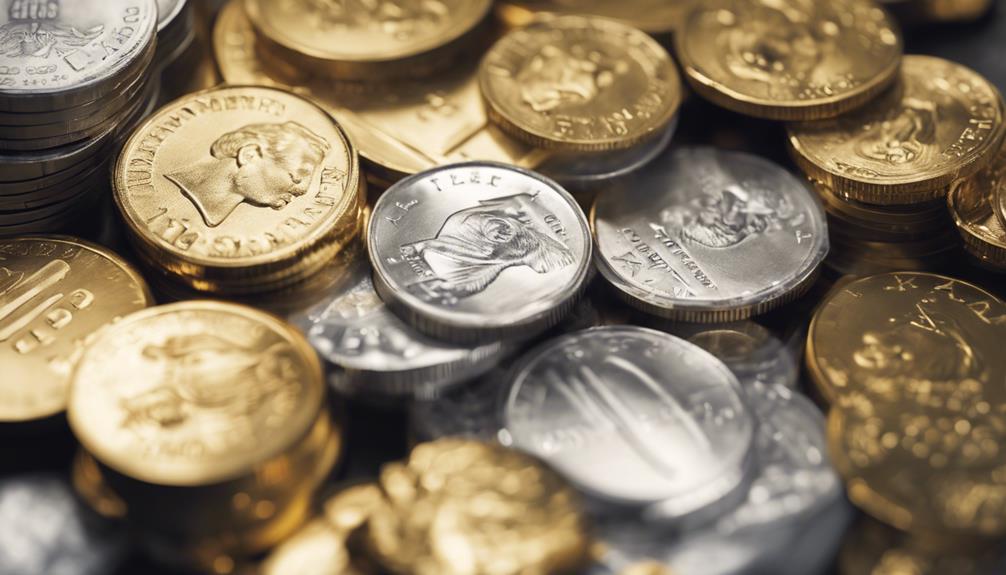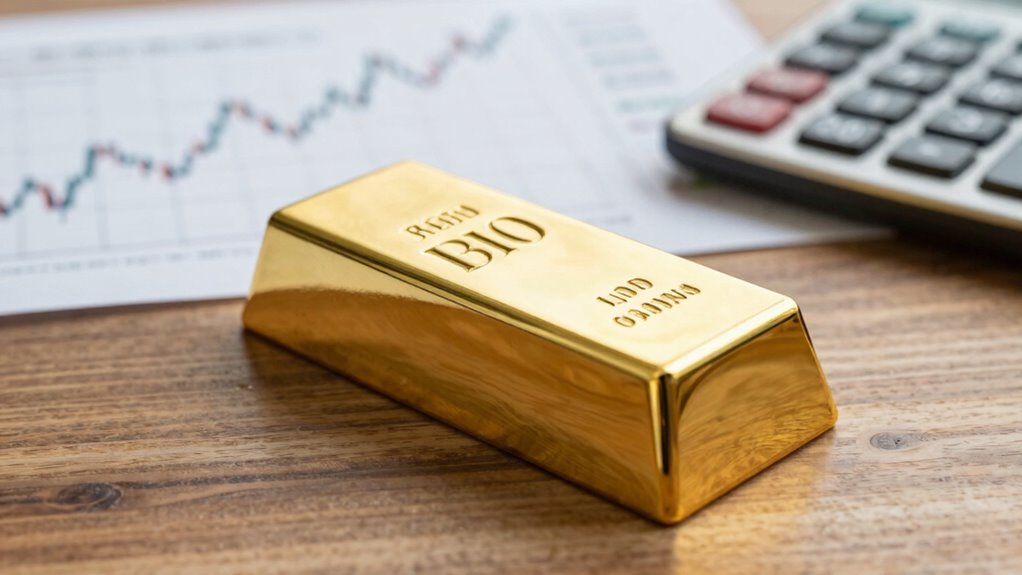

Gold’s reputation as an inflation hedge means it’s seen as a reliable way to protect your wealth when prices rise. It’s valued for maintaining its worth during economic uncertainties and currency devaluations. When monetary policies suggest higher inflation, gold becomes more attractive because it’s not tied to government policies or paper currencies. If you want to understand how gold can help safeguard your investments amid economic fluctuations, explore further insights below.

Get smart everyday buys delivered free — and shop member deals
- Fast, free delivery on millions of items
- Access to Prime Big Deal Days deals on October 6–7
- Prime Video, Amazon Music and more included
Key Takeaways
- Gold is considered a safe store of value during inflation and economic uncertainty.
- Its reputation as an inflation hedge depends on monetary policies and inflation expectations.
- Gold maintains value independently of government policies, reinforcing its role as a stable asset.
- High real interest rates can reduce gold’s effectiveness as an inflation hedge.
- Gold’s reputation reflects its historical performance during crises and its role in diversifying investment portfolios.

Many investors turn to gold when inflation rises, believing it’s a reliable way to protect their wealth. This reputation stems from gold’s historical ability to maintain value when paper currencies falter. During periods of rising prices, people often seek assets that aren’t directly affected by inflation, and gold has long been considered one of those safe havens. But understanding what gold’s inflation-hedge reputation really means requires digging into the relationship between monetary policy, economic stability, and how markets interpret these signals.
Investors view gold as a safe haven during inflation, driven by its historical stability amid economic uncertainties.
When central banks adjust their monetary policy—such as raising interest rates or implementing quantitative easing—they influence inflation expectations. If a central bank signals that it’s committed to controlling inflation, markets tend to stabilize, and gold’s appeal might diminish because the threat of runaway inflation decreases. Conversely, if policies seem loose or stimulative, inflation fears grow, and investors often look for stores of value like gold. It’s not just about the current inflation rate but also the perception of future inflation, which is shaped heavily by monetary policy decisions.
Gold’s reputation as an inflation hedge isn’t purely based on its ability to keep pace with rising prices; it also hinges on its role in maintaining economic stability. When inflation accelerates unpredictably, it can undermine confidence in a country’s currency and financial system. Gold, with its intrinsic value, becomes a safeguard against this instability. Investors see it as a non-fiat asset that isn’t directly tied to government policies or currency fluctuations, offering a sense of security when the economy seems volatile. Additionally, the precious metals market provides a diverse array of investment options beyond just gold, which can serve as a hedge in different economic scenarios. Moreover, the inflation-hedge reputation of gold has been reinforced by its performance during past economic crises, further solidifying its role as a safe investment.
However, this doesn’t mean gold always outperforms during inflationary periods. Its price can be influenced by various factors, including interest rates, currency strength, and investor sentiment. For instance, if real interest rates are high, the opportunity cost of holding gold increases because you forgo yields from interest-bearing assets. That can dampen gold’s inflation-hedging strength, even if inflation is rising. Still, in environments where monetary policy is uncertain or inflation expectations become unanchored, gold’s reputation as a safeguard often comes into play.
In essence, when you hear that gold is an inflation hedge, it’s a reflection of its historical role as a stable store of value amid economic uncertainty. Its effectiveness depends on how well it counteracts the effects of inflation driven by monetary policy and how it contributes to overall economic stability. While not a perfect hedge in every situation, gold remains a critical part of many investors’ strategies to preserve wealth during turbulent times.
As an affiliate, we earn on qualifying purchases.
Frequently Asked Questions
How Does Gold Compare to Cryptocurrencies as an Inflation Hedge?
You find that gold often acts as a reliable inflation hedge due to its historical stability, whereas cryptocurrencies are more volatile. Digital assets like Bitcoin can offer potential gains during inflation, but market volatility makes them riskier. Gold’s tangible nature provides a sense of security, while cryptocurrencies’ rapid price swings can lead to bigger losses. Your choice depends on your risk tolerance and whether you prefer stability or the potential for higher returns.
Can Gold’s Value Decline During Periods of Inflation?
Yes, gold’s value can decline during periods of inflation due to its historical volatility and fluctuations in market liquidity. While many see gold as an inflation hedge, market conditions sometimes cause its price to drop, especially if investors lose confidence or liquidity dries up. You should stay aware that gold isn’t immune to market swings, and its value isn’t guaranteed to rise solely because inflation occurs.
What Are the Costs Associated With Investing in Gold?
Sure, investing in gold comes with some charming costs. You’ll pay storage costs to keep your shiny assets safe—preferably in a vault, not under your mattress. Plus, insurance premiums add to your expenses, guarding against theft or damage. While gold gleams with potential, these hidden costs can chip away at your gains. So, before you plunge in, remember: shiny doesn’t come cheap, and security isn’t free.
How Does Gold Perform During Deflationary Periods?
During deflationary periods, gold generally struggles as economic uncertainty decreases, and people prefer cash or bonds over gold. You might see gold prices decline, especially since gold mining becomes less profitable, reducing supply. Jewelry investments also tend to slow down because consumer demand drops. However, gold’s reputation as a safe haven can sometimes offer some stability, but overall, gold underperforms compared to other assets during deflation.
Is Physical Gold or Gold ETFS a Better Investment?
Are you better off with physical gold or gold ETFs? If you value direct control, physical gold might be your choice, but it requires secure gold storage and may involve higher gold taxation. ETFs offer convenience and liquidity, making them ideal if you prefer ease of trading. Consider your priorities—security, costs, and taxes—before deciding which fits your investment style best. Which option aligns with your financial goals?
As an affiliate, we earn on qualifying purchases.
Conclusion
So, while gold may not be a foolproof shield against inflation, it still holds a certain charm that many find reassuring. Its reputation as a safe haven persists, whispering promises of stability amid economic fluctuations. Keep in mind, no investment is perfect, but gold’s subtle allure might just be worth considering when you’re seeking a quiet corner of security in a noisy world. Sometimes, it’s the understated choices that quietly stand the test of time.
As an affiliate, we earn on qualifying purchases.
precious metals investment guide
As an affiliate, we earn on qualifying purchases.
As an affiliate, we earn on qualifying purchases.
Fall Picks
fall essentials
As an affiliate, we earn on qualifying purchases.