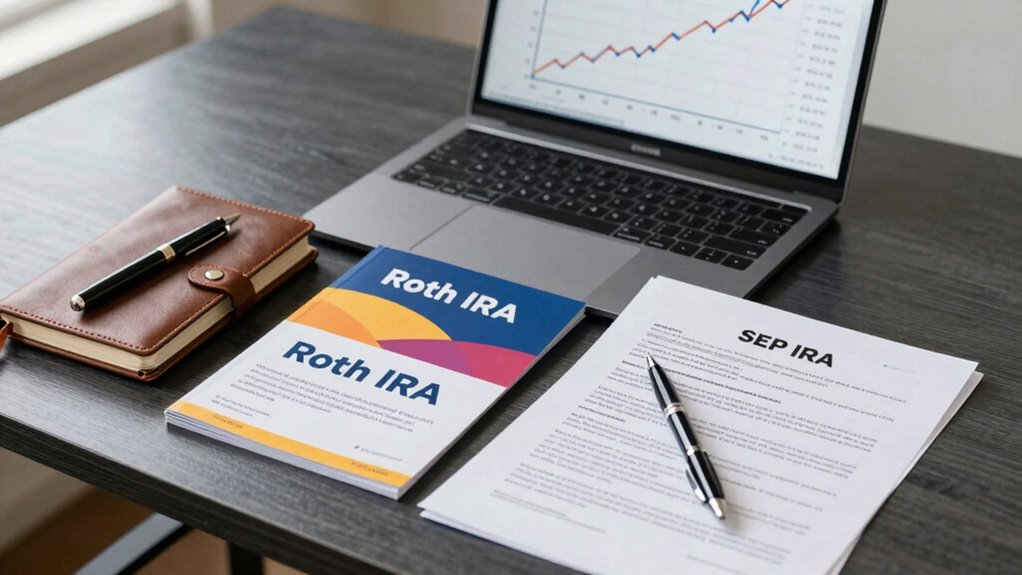

To choose between a Traditional, Roth, and SEP IRA, consider your current income, tax situation, and retirement goals. If you want an immediate tax deduction and flexibility, a Traditional IRA might suit you. If you prefer tax-free growth and expect higher income later, a Roth IRA could be better. For self-employed or small business owners wanting larger contributions, a SEP IRA is ideal. Understanding these differences helps you pick the best option for your future needs.

Get smart everyday buys delivered free with Prime
- Fast, free delivery on millions of items
- Prime Video, Amazon Music and more included
- Member-only deals all year
Key Takeaways
- Consider current tax deductions and whether immediate or future tax benefits align with your financial goals.
- Evaluate your income level and eligibility, especially for Roth IRA contributions which have income restrictions.
- Determine if you are self-employed or a small business owner to benefit from SEP IRA’s higher contribution limits.
- Assess your expected future income and tax rates to choose between tax-free Roth withdrawals or tax-deductible traditional contributions.
- Review contribution limits and rollover options to ensure the IRA type supports your savings capacity and consolidation needs.

Are you unsure which IRA best fits your financial goals? Choosing the right individual retirement account can feel overwhelming, but understanding the key differences can help you make an informed decision. To start, you’ll want to evaluate your current financial situation, future income expectations, and retirement plans. Each IRA type — Traditional, Roth, and SEP — offers distinct benefits, especially when it comes to rollover options and contribution limits. Knowing these details can help you decide which account aligns best with your needs.
Traditional IRAs typically allow for tax-deductible contributions, which can lower your taxable income now. The contribution limits are set annually by the IRS, and for 2023, you’re allowed to contribute up to $6,500—or $7,500 if you’re age 50 or older. Rollover options are a significant advantage if you’re switching jobs or consolidating retirement savings. You can transfer funds from a former employer’s 401(k) or another IRA into a Traditional IRA without incurring taxes or penalties, provided you follow the proper rollover procedures. This flexibility makes it easier to keep your retirement savings consolidated and manageable.
Traditional IRAs offer tax-deductible contributions and flexible rollover options from 401(k)s and other IRAs.
On the other hand, Roth IRAs offer the benefit of tax-free growth and tax-free withdrawals in retirement, which is appealing if you expect your income to increase over time. Contributions to a Roth IRA are made with after-tax dollars, so there’s no immediate tax deduction, but qualified withdrawals are tax-free. The contribution limits are the same as those for a Traditional IRA, but there are income restrictions—if your income exceeds certain thresholds, your ability to contribute directly to a Roth IRA may be phased out. Rollover options are also available from other retirement accounts, allowing you to convert traditional retirement savings into a Roth, which can be advantageous if you anticipate higher tax rates in the future. Additionally, understanding the contrast ratio of a projectors can be helpful if you are considering multimedia presentations for your retirement plans or educational content.
SEP IRAs are designed mainly for self-employed individuals and small business owners. They allow for larger contribution limits—up to 25% of your net earnings or a maximum of $66,000 in 2023—whichever is less. Rollover options are straightforward; you can transfer existing retirement funds into your SEP IRA, making it a flexible tool for consolidating your retirement savings. Because of the higher contribution limits, SEP IRAs are ideal if you want to save more aggressively for retirement and have variable income that can support larger contributions.
In the end, understanding your contribution limits, rollover options, and future tax considerations will help you choose the IRA that best fits your financial goals. Whether you prioritize immediate tax benefits, tax-free growth, or maximizing contributions, each IRA type offers unique advantages suited to different circumstances.
Traditional IRA contribution calculator
As an affiliate, we earn on qualifying purchases.
As an affiliate, we earn on qualifying purchases.
Frequently Asked Questions
Can I Contribute to Multiple IRA Types in the Same Year?
Yes, you can contribute to multiple IRA types in the same year, boosting your retirement savings. However, your total contributions must not exceed IRS annual limits. Keep in mind, this impacts your tax implications differently: Traditional IRAs may give you a tax deduction now, while Roth IRAs offer tax-free growth. Managing contributions across accounts helps optimize your retirement plan while staying within legal limits.
Are There Income Limits for Roth IRA Contributions?
Yes, there are Roth IRA income limits that can feel like a giant gate blocking your way—especially during contribution phase outs. If your income exceeds certain thresholds, your ability to contribute directly gets phased out gradually, making it seem like a steep climb uphill. But don’t worry; strategies like conversions or backdoor Roths can help you bypass these limits and still grow your retirement savings effectively.
How Do I Convert a Traditional IRA to a Roth IRA?
You can convert a traditional IRA to a Roth IRA through an IRA conversion. To do this, contact your IRA provider and request the conversion. Be aware of the tax implications, as you’ll owe income tax on the converted amount, which could increase your tax bill for the year. It’s wise to plan for this, maybe spreading out conversions over several years to manage the tax impact effectively.
What Are the Age Restrictions for SEP IRA Contributions?
In retirement planning, SEP IRA contribution age restrictions are flexible; you can contribute at any age as long as you have earned income. This makes SEP IRAs a smart choice for self-employed individuals or small business owners looking to expand their investment strategies. Unlike other IRAs, age doesn’t limit your ability to contribute, allowing you to maximize your retirement savings regardless of your stage in life.
Can I Rollover Funds From a 401(K) to an IRA?
Yes, you can rollover funds from a 401(k) to an IRA, which is a common move in retirement planning and investment strategies. Doing so allows you to maintain tax advantages and consolidate your savings. You typically have 60 days to complete the rollover once you withdraw funds, so make sure to follow the proper procedures. This strategy helps you manage your retirement savings more effectively and can open up more investment options.
Roth IRA tax-free growth investment
As an affiliate, we earn on qualifying purchases.
As an affiliate, we earn on qualifying purchases.
Conclusion
So, when it comes to choosing your IRA, trust your instincts and consider your future goals. Think of it like planting a seed—you need the right soil and care to grow strong. Whether you go traditional, Roth, or SEP, each has its benefits depending on your situation. Remember, the right choice isn’t just about today; it’s about shaping a secure tomorrow. Pick the one that aligns best with your dreams, and watch your savings flourish.
SEP IRA for self-employed small business
As an affiliate, we earn on qualifying purchases.
As an affiliate, we earn on qualifying purchases.
As an affiliate, we earn on qualifying purchases.
Halloween Picks
halloween
As an affiliate, we earn on qualifying purchases.