
The best financial literacy gifts for kids turn money concepts into something a child can practice, discuss, or revisit. I’d choose Little Economists Box Set 1 as the best overall starting point because its five-book format offers more variety than a single workbook, while Follow the Money stands out for families who want shared play and Money Skills for Kids for children who enjoy structured activities. The main tradeoff is choosing between hands-on play, reading, and independent practice—and matching the format to the child’s age and attention span. Some gifts teach broad money habits, while others focus more narrowly on saving, business, or investing. Read on for the full breakdown and guidance on which type fits your child best.

Get smart everyday buys delivered free with Prime
- Fast, free delivery on millions of items
- Prime Video, Amazon Music and more included
- Member-only deals all year
Key Takeaways
- Little Economists Box Set 1 has an advantage for families seeking variety: five books provide more than one format or topic, though a child who prefers games may get more use from an interactive pick.
- Follow the Money and Finance Go Fish make money learning a social activity; they suit family play better than workbooks, but require someone else to join in.
- The workbook choices serve different needs: Smart Money Detectives uses missions and coloring for ages 7–9, while Money Skills for Kids offers 75 activities for ages 8–12.
- Several products are age-specific, including the supermarket game for ages 5–8 and the 9-year-old workbook, so checking the intended age range matters more than choosing the broadest topic.
- The lineup spans basic saving and spending through business and investing; a focused book such as Investing for Kids makes more sense after a child has some grounding in everyday money choices.




More Details on Our Top Picks
Financial Literacy Flashcards for Kids & Teens – Deluxe Set
Best for growing learners, this set gives families a way to revisit money concepts as a child’s knowledge expands. Its 108 cards span three skill levels, from beginner through advanced, and pair definitions with images and discussion prompts. That progression makes it a more adaptable teaching tool than the single-set 54-Card Financial Literacy Flash Cards for Kids, while the companion activity book adds structured practice beyond card discussions. It suits ages 8–16 and can work for home learning or classroom use. The tradeoff is that the 108-page activity book is digital, so families need to download and print it, and the cards focus more on vocabulary than practical tools such as budgeting software. Choose this set for breadth and progression; skip it if you want a ready-to-play game or a fully self-contained printed workbook.
Pros:- Three skill levels let learners build from introductory terms toward more advanced concepts.
- 108 cards provide broad coverage for repeated lessons.
- Discussion prompts support parent-child or classroom conversation.
- Digital companion activity book adds structured exercises.
Cons:- The activity book must be downloaded and printed.
- Vocabulary-focused lessons offer less practice with applied tasks such as managing a budget.
Best for: Parents or educators looking for a reusable, progressive money-concepts resource for children ages 8–16.
Not ideal for: Families who want a fully printed activity resource or hands-on game play, since the activity book requires printing and the core set centers on vocabulary.
- Brand:The Financial Rewire
- Age range:8–16 years
- Number of cards:108
- Skill levels:Beginner, Intermediate, Advanced
- Included components:108 flashcards, digital activity book, instruction guide, storage box
- Material:Cardboard
- Item dimensions:4.24 x 3 x 0.1 inches
Our verdict“Choose this for a reusable, levelled learning set for older children, but pick a game or printed workbook for more hands-on practice.”
Little Economists Box Set 1 (Books 1-5)
For younger children, five short books can make money topics easier to introduce in small, adult-guided conversations. This set covers money and spending alongside credit cards, inflation, and supply and demand, giving it a wider economics lens than Smart Money Detectives, which centers on saving, spending, and budgeting activities. That breadth is useful for families or teachers who want to connect everyday choices with how markets work. The age range is 4–8, though some ideas may need simplification for children at the youngest end. Unlike a game, the books do not put children in a simulated spending situation, and the introductory coverage may need follow-up resources as a learner grows. Pick this set for read-together lessons; choose an activity workbook or shopping game for more direct practice.
Pros:- Five books give families several topics to explore over time.
- Includes introductory coverage of inflation and supply and demand.
- Reading format supports adult-led discussion at home or in class.
Cons:- Some concepts may be too abstract for children at the lower end of the stated age range.
- Introductory lessons offer limited depth for children ready for more advanced material.
- Books explain concepts but do not simulate spending or budgeting decisions.
Best for: Parents, homeschoolers, and early-years teachers who want to introduce money and basic economics through shared reading with children ages 5–8.
Not ideal for: Four-year-olds who are not ready for abstract topics, or families seeking hands-on budgeting and spending practice rather than books.
- Target age:4–8 years
- Number of books:5
- Topics:Money, spending wisely, credit cards, inflation, supply and demand
- Format:Box set of books
- Set identifier:Books 1–5
Our verdict“Choose this set for guided early reading about money and economics, and choose a game or workbook when you want children to practice decisions themselves.”
The Fidget Game Supermarket Squishy Spree – Money Games for Kids Ages 5-8
Best hands-on money game in this group, Supermarket Squishy Spree gives children a shop-and-spend scenario in which they can count money and make budget-related choices through play. Its tactile pieces and clear visuals offer a more active route into money skills than the reading-based Little Economists Box Set 1 or the discussion-led deluxe flashcards. A short 15–20-minute playtime also makes it easier to fit into a family evening or tutoring session. The stated player count is two to five, so it is less suitable for a whole class playing together without extra sets or rotation. Its age focus may also leave older children wanting more complex choices. Pick it for younger learners who benefit from concrete, screen-free practice; skip it if your child prefers reading or needs advanced financial topics.
Pros:- Play-based shopping gives children practice counting dollars and coins.
- Tactile pieces and clear visuals support varied learning needs.
- Screen-free play fits family, tutoring, and classroom settings.
- Short stated playtime suits brief learning sessions.
Cons:- The two-to-five-player limit can restrict use with larger groups.
- The age focus may not hold the interest of older children.
- Game play provides less topic breadth than the 108-card deluxe flashcard set.
Best for: Families, tutors, and early-primary teachers seeking a short, tactile shopping-and-money game for children ages 5–8.
Not ideal for: Older children seeking deeper financial concepts or larger groups that need everyone to play at once.
- Recommended age:36 months–8 years
- Number of players:2–5
- Playtime:15–20 minutes
- Product dimensions:10.63 x 10.24 x 3.15 inches
- Item weight:3.03 pounds
- Model number:TFG-SSS-MONEY
Our verdict“Choose this for young children who learn best by handling and spending play money, but look elsewhere for larger groups or advanced topics.”
Financial Literacy Flash Cards for Kids, 54-Card Set
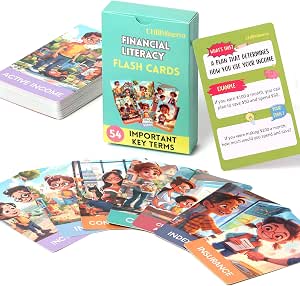
For families who want compact prompts rather than a long curriculum, this 54-card set connects explanations to a real-life case study and a question on each card. The combination can help turn a short session into a conversation about saving, budgeting, investing, cash flow, stocks, or debit. Compared with the Financial Literacy Flashcards for Kids & Teens – Deluxe Set, this set has fewer cards and no stated skill levels or companion activity book, so it is simpler to pick up but less clearly built for progression. Its illustrations and portable format suit home, classroom, or travel use. The tradeoff is limited depth: it is designed for children and will not satisfy learners seeking advanced instruction or sustained practice. Choose it for brief discussions, not as a complete financial curriculum.
Pros:- Each card combines an explanation, case study, and question.
- Covers varied topics, including saving, budgeting, investing, and debit.
- Illustrations support discussion with younger learners.
- Suitable for home, classroom, and travel use.
Cons:- The 54-card set offers less breadth than the 108-card deluxe set.
- No activity book or skill-level progression is listed.
- Child-focused explanations may be too introductory for advanced learners.
Best for: Parents and educators who want a portable set of illustrated prompts for short money conversations with children ages 6 and up.
Not ideal for: Families wanting a staged curriculum, extended exercises, or advanced financial instruction.
- Brand:UHillMinerva
- Age range:6 years and up
- Card count:54
- Educational objective:Financial literacy
- Included components:54 flashcards
- Topics:Saving, budgeting, investing, cash flow, stocks, debit
Our verdict“Choose this for portable, conversation-led learning, but select the deluxe set or a workbook for more structured progression and practice.”
Smart Money Detectives: Financial Literacy Activity & Coloring Workbook for Kids Ages 7-9 – 9 Money Missions + 3 Bonus Missions to Learn Saving Skills
Best for activity-based practice, this detective-themed workbook turns saving, spending, and budgeting into nine core missions plus three bonus challenges. Puzzles, worksheets, and coloring pages give children ages 7–9 something to do with the ideas, unlike the discussion-first 54-Card Financial Literacy Flash Cards for Kids. The workbook format also makes it easier to work through a mission at a time rather than organize a full game. Its scope is narrower than the deluxe flashcards’ broader vocabulary coverage, and some activities may call for an adult to explain instructions or talk through a choice. The age band is specific, too, so it may not stay useful as a child moves beyond these early lessons. Choose it for a child who enjoys coloring and puzzles; skip it if you want a reusable group game or broad economics coverage.
Pros:- Nine core missions and three bonus challenges provide a clear activity sequence.
- Puzzles, worksheets, and coloring offer varied ways to engage.
- Focuses on practical introductory themes of saving, spending, and budgeting.
- Workbook format supports short, individual practice sessions.
Cons:- The age range limits usefulness for children outside ages 7–9.
- Some activities may need adult guidance.
- Its core topics are narrower than the deluxe flashcard set’s financial vocabulary.
Best for: Caregivers of children ages 7–9 who enjoy puzzles and coloring and benefit from a structured, mission-by-mission workbook.
Not ideal for: Families seeking a multiplayer game, wide-ranging economics lessons, or material that spans several age stages.
- Age range:7–9 years
- Format:Activity and coloring workbook
- Core missions:9
- Bonus missions:3
- Topics:Saving, spending, budgeting
- Activity types:Puzzles, worksheets, coloring pages
Our verdict“Choose this for a 7–9-year-old who likes guided puzzles and coloring, but pick flashcards or a game for broader or shared learning.”
Follow the Money – A Fun Financial Literacy Game for Kids
Follow the Money is the most broadly approachable pick here for families who want money lessons to come up during shared play. Its focus on budgeting, saving, and smart spending gives children a chance to think through everyday choices, rather than only memorize terms. Compared with My First Little Business, which frames money around entrepreneurship and investing, this game appears better suited to a general introduction to household money decisions. That broad focus is also its limitation: the available details do not specify an age range, player count, or components, so it is harder to judge its fit before buying. The stated tradeoff is limited replay value once children have mastered the basic concepts. Choose it for a first group activity, not for a strategy game meant to stay challenging over time.
Pros:- Introduces budgeting, saving, and spending through interactive gameplay.
- Designed for family and classroom group play.
- Prompts children to think about financial choices rather than only read about them.
Cons:- Replay value may fade after children learn the core concepts.
- No age range or player count is provided in the available product details.
Best for: Families or educators seeking a group game to start conversations about budgeting, saving, and spending.
Not ideal for: Buyers who need a confirmed age range, player count, or detailed component list, or children who want deeper business strategy and lasting replay.
- Product type:Financial literacy board game
- Core topics:Budgeting, saving, and smart spending
- Play setting:Families and classrooms
- Play style:Interactive group play
- Learning focus:Financial decision-making
- Age range:Not specified
Our verdict“Choose Follow the Money for a straightforward group introduction to everyday money choices, but skip it if you want specified age guidance or sustained strategic challenge.”
My First Little Business Financial Literacy Game, Kids Money Board Game
My First Little Business gives money lessons a clear storyline: players build businesses while earning, spending, saving, and investing. That makes it a stronger fit for children curious about how money can support a goal than Follow the Money, which focuses more broadly on budgeting and spending choices. Its board, cards, pretend money, and die create a hands-on way to practice strategy, and the stated ages 8–12 make the intended audience easier to identify than for several options here. The tradeoff is a small table group: play is limited to 2–4 players, so it may not work for a full classroom without multiple sets or groups. Cardstock components and small parts also call for care around younger siblings. Pick this for focused family play, not large-group use.
Pros:- Connects earning, saving, spending, and investing to a business-building goal.
- Includes a board, cards, pretend money, and a die for hands-on play.
- Strategy mechanics encourage planning and entrepreneurial thinking.
- Provides a stated age range of 8–12.
Cons:- Limited to 2–4 players, which restricts whole-class play.
- Small parts may pose a choking hazard for younger children.
- Cardstock components may be less durable than sturdier game pieces.
Best for: Families with children ages 8–12 who enjoy strategy games and want money lessons tied to starting and growing a business.
Not ideal for: Large classrooms that need one game for many players, or households with young children who may handle small parts.
- Brand:Clever Fox Play
- Minimum age:8 years
- Player count:2–4
- Language:English
- Genre:Educational, Money & Assets, Strategy
- Game mechanics:Strategy
- Materials:Cardstock
- Unit count:87
- Item dimensions:10.3 x 8.2 x 0.1 inches
Our verdict“Choose this for ages 8–12 who like business strategy and can play in a small group; pick another option for larger groups.”
Investing for Kids: How to Save, Invest, and Grow Money
Investing for Kids: How to Save, Invest, and Grow Money is the most direct choice here for a child ready to move beyond basic spending and saving. It introduces saving and investing in simple language, with real-world examples and activities intended to make abstract ideas easier to discuss. Compared with the activity-heavy Money Skills for Kids workbook, this book has a narrower investing focus; that makes it a better match for a specific interest, but less of an all-purpose money curriculum. Parents and educators can use the examples to start conversations, though the supplied details do not state an age range or provide a contents breakdown. Its coverage also stops short of complex investing subjects such as taxes and portfolio diversification, so older children seeking more depth may outgrow it. Choose it as an approachable first investing read, not an advanced guide.
Pros:- Uses simple language to introduce saving and investing.
- Real-world examples and activities can support discussion and practice.
- Offers a focused introduction to growing money.
- Can be used at home, in classrooms, or in homeschool lessons.
Cons:- May be too basic for older children or teens seeking more advanced material.
- Does not cover complex topics such as taxes or portfolio diversification.
- The available product details do not specify an age range.
Best for: Parents, teachers, and homeschool educators introducing children to saving and investing through accessible explanations and practical examples.
Not ideal for: Older children or teens looking for advanced investment strategy, or buyers who need a specified age range and detailed topic list.
- Format:Book
- Main topics:Saving, investing, and growing money
- Teaching approach:Simple language and real-world examples
- Activities:Activities included
- Intended users:Children, parents, and educators
- ASIN:1647398762
Our verdict“Choose this book for a child curious about investing basics, but pick the broader Money Skills for Kids workbook for a wider range of money topics.”
Prop Money Checkbook Set – Sea Animal Theme, 6 x 3 in, 150 Sheets
Prop Money Checkbook Set takes a different route from the games and books in this roundup: children practice money concepts by filling out checks, deposit slips, and registers. Those paper tools can connect addition and subtraction with a familiar financial routine, making the set a possible fit for guided play or classroom exercises. Its 150 sheets give educators material for repeated activities, unlike a focused read such as Investing for Kids. The age range listed is 12 months to 5 years, but check writing itself will need adult guidance and may suit children near the older end of that span better. The paper can tear with rough handling, and the 6 x 3-inch checks may feel cramped for older writers. Choose it for supervised practice, not as a complete lesson in budgeting or investing.
Pros:- Includes 100 checks, 40 deposit slips, and 10 registers for varied practice.
- Can link check writing with addition and subtraction exercises.
- Sea-animal theme offers a child-friendly visual design.
- Large sheet count supports repeated homeschool or classroom activities.
Cons:- Paper components may tear with rough handling.
- The 6 x 3-inch check size may be cramped for older children.
- Checkbook practice alone offers a narrower view of financial literacy than a broader game or workbook.
Best for: Parents and early-years educators who want reusable classroom-style practice with pretend checks, deposits, and basic arithmetic.
Not ideal for: Older children who need larger writing space or broader lessons in budgeting and investing, and toddlers likely to tear or mouth paper pieces.
- Brand:Infinite Curiosity
- Model number:BOYCK
- Age range:12 months–5 years
- Check size:6 x 3 inches
- Checks:100
- Deposit slips:40
- Check registers:10
- Total sheets:150
- Theme and color:Sea animal; blue and white
Our verdict“Choose this set for supervised early math and check-writing activities, but select a broader resource for children ready to learn budgeting or investing.”
Money Skills for Kids: A Fun Financial Literacy Workbook for Ages 8 to 12 with 75 Activities, Games and Puzzles
Money Skills for Kids suits children ages 8–12 who learn by doing and benefit from short, varied tasks. Its 75 activities, games, and puzzles cover earning, saving, budgeting, and spending, giving it broader topic coverage than Investing for Kids, which centers on saving and investing. As a workbook, it also lets a child work through ideas at their own pace rather than needing a group, as My First Little Business does. The tradeoff is that the experience stays on paper: there is no digital component, and the supplied description does not identify particular activity formats beyond games and puzzles. Its age range is also specific, so older readers may find the material too basic. Pick this for structured practice across several everyday money topics, not for interactive group play.
Pros:- Provides 75 activities, games, and puzzles for varied practice.
- Covers earning, saving, budgeting, and spending.
- Stated age range of 8–12 helps families judge its intended fit.
- Workbook format supports individual, classroom, or homeschool use.
Cons:- Paper-only format has no app or digital interaction.
- Older children may find the content too basic.
- Does not provide the group interaction of a board game such as My First Little Business.
Best for: Families and educators seeking a structured paper activity resource for children ages 8–12 learning everyday money skills.
Not ideal for: Older children who want more advanced financial lessons, or buyers looking for a digital tool or a group board game.
- Format:Workbook
- Age range:8–12 years
- Number of activities:75
- Activity types:Activities, games, and puzzles
- Topics:Earning, saving, budgeting, and spending
- Digital component:None specified; described as paper format
Our verdict“Choose this workbook for ages 8–12 who want broad, self-paced money practice, and choose a game instead if shared play is the priority.”
Financial Literacy Workbook for 9-Year-Olds – Complete 4th Grade Workbook with Lessons and Fun Activities to Build Smart Spending and Saving Habits
This workbook suits families looking for structured money lessons for a specific age. Its fourth-grade focus gives nine-year-olds a more tailored starting point than How to Make Money, which introduces simpler ideas for younger readers. Lessons paired with activities can help children connect concepts like saving, budgeting, and spending with decisions they can discuss at home or in class. The tradeoff is the same age focus that makes it appealing: children outside that level may find the material too easy or too difficult, and the supplied details do not specify the number of activities or pages. Compared with Finance Go Fish, this is a quieter, workbook-based option rather than a game built around recalling vocabulary and talking through definitions.
Pros:- Designed for nine-year-olds and fourth-grade learners, supporting age-relevant explanations.
- Pairs instructional lessons with activities to give children more than definitions to read.
- Covers practical habits including budgeting, saving, and smart spending.
- Can be used by parents or teachers to support discussion and practice.
Cons:- Its fourth-grade level may not challenge older or financially experienced children.
- The supplied product details do not specify workbook length or the number of activities.
Best for: Parents and fourth-grade teachers seeking guided lessons and activities for children around age nine who are ready to practice saving, budgeting, and spending.
Not ideal for: Older children or advanced learners who need more challenging financial concepts, and families looking for a group game rather than workbook activities.
- Intended age:9 years old
- Grade level:4th grade
- Format:Workbook
- Learning approach:Lessons and activities
- Key topics:Smart spending, saving, and budgeting
- Suggested users:Parents and teachers
Our verdict“Choose this workbook for a nine-year-old who benefits from age-targeted lessons and practice, but skip it if you need a flexible resource for older children.”
How to Make Money: A Fun Financial Literacy Book for Kids Ages 5+ – Learn About Earning, Teamwork, and Making a Difference (Little Economists)
For a young child just starting to ask where money comes from, this book offers a gentle introduction through storytelling, rather than the grade-specific practice in Financial Literacy Workbook for 9-Year-Olds. Its focus on earning, teamwork, and making a difference links money to cooperation and community, giving parents natural openings for conversation. That broader social angle distinguishes it from a workbook centered on saving, budgeting, and spending. The tradeoff is limited depth: the material may feel basic beyond about age seven, and it is not presented as a full curriculum. Compared with Finance Go Fish, which introduces more demanding financial vocabulary through play, this is the more approachable choice for a first encounter with economic ideas.
Pros:- Ages five and up make it suitable for early conversations about money.
- Storytelling offers a less formal entry point than a workbook or vocabulary card game.
- Connects earning with teamwork and making a difference in the community.
- Part of the Little Economists series for families interested in related books.
Cons:- The concepts may be too basic for many children older than seven.
- It offers limited depth for families seeking a comprehensive financial curriculum.
Best for: Parents of preschool and early elementary children who want a read-together introduction to earning money, cooperation, and community impact.
Not ideal for: Children older than seven who want more advanced financial concepts, or caregivers seeking a detailed curriculum with extensive practice.
- Target age:5+
- Series:Little Economists
- Genre:Financial literacy / children’s education
- Format:Children’s book
- Key topics:Earning, teamwork, and making a difference
- Learning approach:Storytelling with simple lessons
Our verdict“Pick this for a young child’s first money story, but choose the fourth-grade workbook or Finance Go Fish for more sustained practice or harder concepts.”
Finance Go Fish – 3-in-1 Financial Literacy Card Game (Ages 5‑12)
Finance Go Fish is the pick for families who want money terms to prompt conversation, not just appear on a page. It adapts Go Fish, Memory Match, and Old Maid, with players reading definitions aloud when they make matches. That makes it more interactive than Financial Literacy Workbook for 9-Year-Olds, while its terms—such as inflation, diversification, and risk tolerance—reach beyond the basic earning ideas in How to Make Money. That added difficulty is also its main limitation: beginners and younger children may need an adult to explain the vocabulary, despite the product title’s broad age range. The listed specs say ages 10–16, which conflicts with the title’s ages 5–12; I would treat it as a better fit for older children who can handle reading and discussion.
Pros:- Three familiar game formats give families options for practicing the terms.
- Read-aloud definitions prompt discussion and provide context for vocabulary.
- Includes concepts such as inflation, diversification, and risk tolerance.
- Comes with 56 cards, rule cards, a holder, and a digital coloring book download.
Cons:- The product title and listed age-range spec conflict, making age suitability less clear.
- Intermediate-to-advanced vocabulary may frustrate beginners without adult guidance.
- Listed for one to four players, limiting use with larger groups.
Best for: Families with older elementary or teen players who can read financial definitions and benefit from talking through unfamiliar terms together.
Not ideal for: Children who are just learning basic money ideas, players who need a consistent age recommendation, or groups larger than four.
- Listed age range:10–16 years in specs; title also states ages 5–12
- Manufacturer:Financial Rewire
- Players:1–4
- Estimated playing time:15 minutes
- Cards:56 cards: 28 term pairs and 1 Old Maid card
- Material:Cardstock
- Game formats:Go Fish, Memory Match, and Old Maid
- Included components:Rule cards, card holder, and digital coloring book download
- Edition:Intermediate to Advanced
Our verdict“Choose this for older children ready to discuss financial vocabulary through card games, not for a young beginner who needs basic concepts explained first.”
Paycheck to Billionaire: Master Financial Freedom – Smart Investing & Cost Management Board Game
This is the most involved group activity in this batch: Paycheck to Billionaire supports two to six players and about 45 minutes of play, making it better suited to a planned family game session than a quick lesson. Its board-game format frames cost management, investing, and economic decisions as strategic play. Compared with Finance Go Fish, it brings a larger group together around a shared game, while Go Fish is shorter and more focused on recalling financial terms. The tradeoff is time and complexity: the rules or concepts may overwhelm younger players, even with the listed minimum age of eight, and a 45-minute session may not suit a casual attention span. Families wanting a quieter, self-paced activity may prefer the fourth-grade workbook instead.
Pros:- Supports two to six players, making it suitable for family or classroom groups.
- Uses strategic play to introduce investing, cost management, and economic principles.
- Includes a large assortment of play cards, banknotes, and other game pieces.
- Offers a longer shared activity than the 15-minute Finance Go Fish game.
Cons:- The 45-minute playing time may be too long for short sessions or younger players.
- Rules and financial concepts may be difficult for children at the minimum recommended age.
- Requires a group, unlike a workbook that a child can use independently.
Best for: Families or classrooms with two to six players who want a substantial, shared game session about investing, cost management, and economic choices.
Not ideal for: Children who are new to money concepts and need a simple first lesson, or families looking for a quick activity under 45 minutes.
- Minimum age:8+ years
- Players:2–6
- Playing time:About 45 minutes
- Manufacturer:Venture Catcher
- Edition:US Edition
- Included cards:100 play cards
- Included banknotes:240
- Other included components:Game map, 2 dice, 5 stop signs, 40 upgrade arrows, 6 Eye of Providence pieces, user manual, and card organizer
Our verdict“Choose this for a family that wants a longer, group-based strategy game, but not as the simplest introduction to money for a young beginner.”

How We Picked
I compared these gifts by how clearly they connect a child with practical money ideas, how well their format fits the stated age range, and whether the learning is suited to solo use, guided reading, or group play. I also weighed variety and repeat use: a multi-book set or activity collection can offer more ways to revisit concepts, while a focused game may be easier to bring out for a short shared session.
The order favors options that offer a useful mix of accessible learning and flexibility, then distinguishes specialized picks by the child or situation they suit best. A game is not ranked above a workbook simply for being interactive, and a broad title is not automatically the right choice for every child. The list includes different formats and topics so families can match the gift to age, interests, and the kind of money conversation they want to start.
Factors to Consider When Choosing Financial Literacy Gifts For Kids
Before choosing, I’d match the gift to how the child likes to learn and what money skill they are ready to explore. These broader questions can help avoid a common mismatch: buying a useful-sounding resource that does not fit the child’s age, interests, or the amount of adult involvement available.
Match the format to the child’s attention and interests
A child who likes conversation and taking turns may get more from a game than from a workbook, while a reader may prefer a book they can revisit alone. Think about what the child chooses during ordinary play, not only what sounds educational to an adult. Hands-on formats can make abstract ideas easier to talk about, but they often depend on another player or a shared session. Workbooks offer a more independent pace, though they may feel like schoolwork to a child who already has a full schedule. A small gift that gets used repeatedly can teach more than a longer resource that stays untouched. When you are unsure, choose the format the child already enjoys and let money concepts be the new part.
Treat age ranges as a starting point, not a reading guarantee
Age labels offer a rough guide to topic and activity design, but children vary in reading fluency, patience, and familiarity with money. Check whether an activity expects independent reading, adult explanation, or comfort with arithmetic before buying. A younger child may enjoy a game about shopping while finding a text-heavy book frustrating. An older child may still benefit from basic saving lessons if the examples feel relevant rather than childish. Avoid choosing only by the highest age range, since an advanced topic can lose a child before it becomes useful. Consider the child’s current skills and interest in the subject together.
Decide how much adult participation fits your household
Games can create useful family conversations, but they are less convenient when no one has time to play. A workbook or book may suit a child who likes quiet independent activities, while a game can work better for siblings or a family gift session. Adult involvement also changes how children interpret concepts such as earning, saving, and investing. You do not need to be a finance expert, but being available to discuss an example can make a lesson more meaningful. Before buying, ask whether the gift should work on its own or act as a shared activity. This practical choice can matter more than the number of topics listed on the package.
Choose one useful learning goal instead of chasing every money topic
Financial literacy includes everyday choices as well as business and investing, and a single gift does not need to cover everything. For a child still learning basic habits, saving and spending may be a more accessible starting point than investment concepts. A child who already asks about running a business may respond better to an entrepreneurship-focused game or book. Broad resources can give a family options, while focused ones may make one topic easier to discuss. A common mistake is choosing the most advanced-sounding subject because it seems more valuable. Start with the money question the child already asks, then build outward as their understanding grows.
Look for repeat use, not just a large activity count
A high number of pages, cards, or missions can sound appealing, but the useful measure is whether the child will return to the material. Reusable games may support repeated practice, while a workbook can be a better fit for a child who likes completing one activity at a time. Books can remain useful as children grow if the examples invite conversation, but a narrow topic may have less reach outside that interest. Consider whether the gift can be shared with siblings or revisited at a later age. Also think about storage and setup: a resource that is easy to take out is more likely to become part of routine play. Choose lasting engagement over volume alone.
Pay for a better fit, not a more impressive label
A premium-feeling gift is worthwhile when its format, range, or replay value matches the child’s needs. A multi-part set can suit a family that wants several reading options, while a focused book or compact card game may be a better fit for a child who prefers one clear activity. Do not assume that a more advanced title will teach more effectively or that more components automatically mean more use. Check the age guidance, the kind of participation required, and the specific money skill covered. For a first gift, an approachable introduction often makes more sense than an expansive resource aimed at several topics. The best choice is the one that will prompt a real conversation or repeat activity.
Frequently Asked Questions
Which kind of financial literacy gift works best for a child who is just starting to learn about money?
I’d start with a resource built around familiar ideas such as earning, saving, or spending rather than investing terminology. A picture-led book or age-matched game can make those ideas easier to discuss without requiring a child to work through a long sequence of written lessons. The right choice depends on whether the child enjoys reading, coloring, or playing with someone else. If the child is young, adult participation can help connect a game’s examples to everyday choices. A first gift should invite questions, not feel like a test.
Should I choose a workbook or a money game for a child who dislikes school-style activities?
A game is often the safer starting point for a child who resists worksheets, since play can give money choices a natural context. Still, check whether the game needs several players and whether your household can make time for it. If shared play is unlikely, a short, colorful activity book may be easier to use than a lengthy workbook. Avoid treating a large activity count as proof that a workbook will hold attention. The child’s usual play preferences are a better guide than the format’s educational label.
Is an investing book appropriate for a child who has not learned basic saving habits?
It can be, if the child is curious about investing and an adult can help explain unfamiliar ideas. For many children, though, saving and spending offer more immediate examples they can connect to allowance or small purchases. A book focused on investing is narrower than a broad introduction, so it may not replace basic money lessons. You can pair it with everyday conversations about setting goals and making choices rather than expecting the book to teach everything. Let the child’s questions and readiness guide the timing.
Are card games a good gift when siblings are different ages?
They can work well when the age range and reading demands suit both players, but a shared label such as “for kids” does not mean every child will find the game equally easy. Check the stated age guidance and whether younger players need help reading cards or understanding the rules. A cooperative adult or older sibling can make mixed-age play more welcoming. If one child is likely to dominate, a workbook or book for each child may be fairer. Choose a game when the group enjoys playing together, not simply because it promises family participation.
How can I tell whether a financial literacy gift will get used after the first session?
Look for a format that fits an activity the child already enjoys and a topic they have shown interest in. Games benefit from easy access and willing players; books and workbooks work best when the child likes reading or completing tasks independently. A resource with several ways to revisit ideas may have broader staying power, but variety alone cannot guarantee repeat use. Consider when and where the gift could fit into family routines before choosing. If you can name a realistic moment for using it, the match is more promising.
Conclusion
For a flexible starting point, I’d pick Little Economists Box Set 1 as the best overall choice because its five-book format gives families more than one way to approach money topics. For best value in learning variety, the 75-activity Money Skills for Kids workbook is a strong fit for ages 8–12, while Smart Money Detectives is better for younger children who respond to missions and coloring. For beginners ages 5–8, the supermarket game offers a play-led entry point; for a premium-style gift with several reading options, choose the Little Economists set. Families seeking a specific focus can turn to Investing for Kids for investing interest, My First Little Business for entrepreneurship play, or Follow the Money for shared game time. Match the gift to the child’s age, interests, and willingness to read, write, or play with others.