
TL;DR

Get smart everyday buys delivered free with Prime
- Fast, free delivery on millions of items
- Prime Video, Amazon Music and more included
- Member-only deals all year
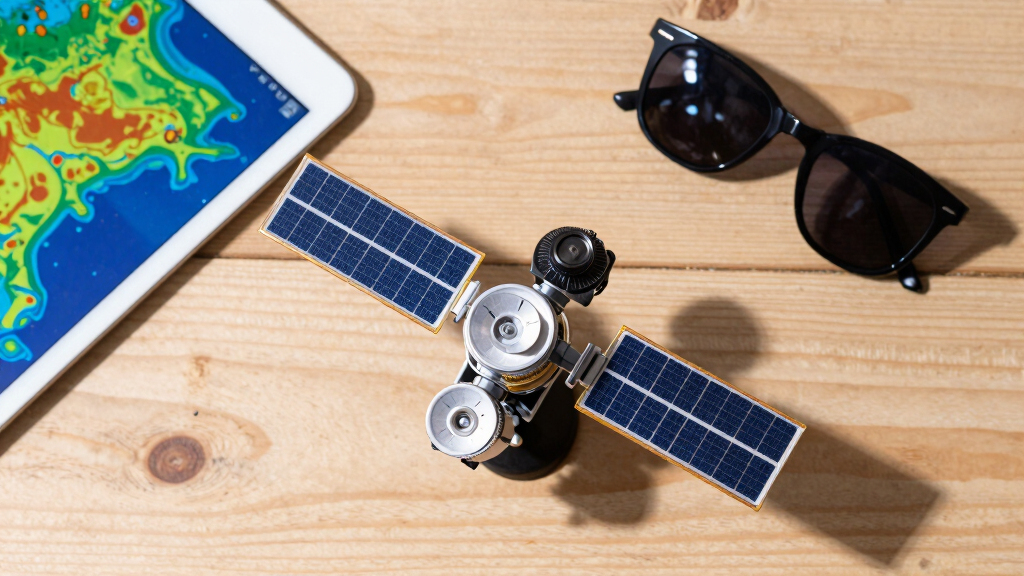
A Chinese research team has created a satellite-based model that accurately estimates the surface temperature of photovoltaic panels in large solar farms. Using MODIS satellite data, the method corrects for mixed pixels and array geometry, enabling more reliable performance monitoring from space. Validation shows significant error reduction, but winter conditions remain challenging.
A Chinese research team has developed a new satellite-based model that accurately estimates the surface temperature of photovoltaic panels in large solar farms, addressing a key challenge in remote sensing of solar energy installations. This method, based on MODIS thermal infrared data, corrects for mixed land-cover signals and array-specific effects, enabling more precise performance monitoring from space. The development matters because it enhances the ability to evaluate solar farm efficiency remotely, supporting better operational decisions and grid integration.
The team’s approach leverages moderate-resolution thermal infrared satellite data from NASA’s MODIS sensors, which typically cover large areas that include PV panels, ground gaps, and surrounding terrain. To isolate the PV panel temperature, the researchers used high-resolution Sentinel-2 imagery to estimate the fractional coverage of panels within each satellite pixel. They then applied a three-dimensional geometric model of the PV arrays, accounting for tilt, azimuth, row spacing, and satellite viewing angles, to determine the visible panel surface area from space.
By explicitly modeling the thermal contribution of non-panel components such as ground and inter-row spaces, the method corrects the mixed radiance signals. Validation against ground measurements from two large PV plants in China showed a substantial reduction in error, lowering the root mean square error (RMSE) from over 10°C to below 9°C, and significantly reducing the systematic cold bias from about -10°C to near -2°C. These improvements translate into a 3-5% reduction in PV power prediction bias, making satellite-based performance estimates more reliable.
However, the researchers noted that winter conditions, with long shadows and snow cover, still pose difficulties, often leading to underestimated panel temperatures. They plan to develop methods to better account for shaded gaps and snow-covered areas in future iterations of the model.
Enhanced Satellite Monitoring of PV Panel Temperatures
This breakthrough enables more accurate remote assessment of solar farm performance, which can improve operational efficiency, maintenance planning, and energy yield forecasts. It supports the integration of satellite data into routine PV performance monitoring and can help identify issues across large-scale installations without on-site measurements. The improvement in accuracy also reduces the uncertainty in satellite-based energy modeling, benefiting utilities, investors, and policymakers.
As an affiliate, we earn on qualifying purchases.
Advances in Satellite-Based Solar Farm Monitoring
Remote sensing of PV panel temperatures has long been hindered by mixed land cover within satellite pixels and the complex geometry of solar arrays. Traditional land surface temperature retrievals often underestimate PV temperatures due to low and directional emissivity of panels and the presence of non-panel surfaces. Previous efforts lacked the scene-aware corrections now introduced by this new model. The use of MODIS data, with 1 km resolution, was limited in accuracy until this pixel decomposition and array geometry correction method was developed. Validation against ground measurements in China marks a significant step forward, especially given the diversity of climate conditions at the test sites.
“Our method goes beyond conventional land surface temperature retrievals by accounting for the three-dimensional structure of PV arrays, changes in the apparent panel area with viewing angle, and the unusually low, directional emissivity of PV panels.”
— Kun Yang, corresponding author
PV panel performance measurement device
As an affiliate, we earn on qualifying purchases.
As an affiliate, we earn on qualifying purchases.
Winter Conditions Limit Satellite Temperature Accuracy
While the model performs well in warm seasons, winter conditions present ongoing challenges. Snow cover and long shadows cause underestimation of panel temperatures, and the team is still developing methods to address these issues. It remains unclear how well future corrections will perform across different climates and array configurations.
As an affiliate, we earn on qualifying purchases.
Expanding Validation and Improving Winter Estimates
The research team plans to test the model on additional solar farms with varied designs and climates, including fixed-tilt and tracking systems. They aim to refine algorithms to better account for shaded and snow-covered areas during winter. Long-term, the goal is to produce a global dataset of PV panel temperatures to support research and industry applications.
thermal infrared sensor for solar panels
As an affiliate, we earn on qualifying purchases.
As an affiliate, we earn on qualifying purchases.
Key Questions
How does this satellite model improve PV performance monitoring?
It provides more accurate estimates of panel surface temperatures from space, reducing errors that previously limited remote performance assessments.
What are the main challenges remaining for winter conditions?
Shadows and snow cover cause underestimation of panel temperatures, and the team is working on methods to correct these effects.
Can this method be applied globally?
The team aims to validate and adapt the model for diverse climates and array types, with the goal of creating a global PV temperature dataset.
What impact does this have on solar farm operators?
More accurate satellite-based temperature data can improve operational decisions, maintenance scheduling, and energy yield predictions.
Source: PV Magazine
Fall Picks
fall essentials
As an affiliate, we earn on qualifying purchases.