To verify your gold bar’s purity and authenticity, start by inspecting its surface for consistent color, shine, and markings like serial numbers or hallmarks from reputable refineries. Measure its weight and dimensions accurately, then calculate the density—genuine gold is about 19.3 g/cm³. Use non-destructive tests like portable XRF analyzers to confirm its metal composition. For thorough assurance, combining these steps with advanced techniques can reveal if your gold bar is truly authentic.
Key Takeaways
- Examine surface markings, hallmarks, and engravings for consistency, clarity, and official certification stamps.
- Measure dimensions and weight accurately; calculate density to compare with the standard 19.3 g/cm³ for gold.
- Perform acid tests and use portable XRF analyzers to verify the metal’s composition and purity on-site.
- Inspect surface quality for dents, scratches, discoloration, or irregularities indicating tampering or plating.
- Utilize advanced non-destructive testing methods like ultrasonic scans and magnetic measurements to detect internal flaws and counterfeit materials.
Physical Inspection and Dimensional Verification

When verifying a gold bar’s authenticity through physical inspection, start by carefully examining its size and weight. Genuine gold bars have precise dimensions and weight standards set by refiners. Use a calibrated scale to weigh the bar accurately; it should match the expected weight for its size. Measure its length, width, and thickness with a ruler or caliper, ensuring these match the official specifications. Be cautious of irregularities or inconsistencies, as counterfeit bars often have slight deviations. Check the surface for any dents, scratches, or irregularities, which could indicate tampering or damage. Handling the bar gently, feel its density—gold is particularly dense and heavy for its size. These physical cues help you make an initial assessment before proceeding with more detailed tests. Also, familiarize yourself with common slang terms used by counterfeiters to spot potential red flags during physical inspection.
Analyzing Hallmarks and Markings

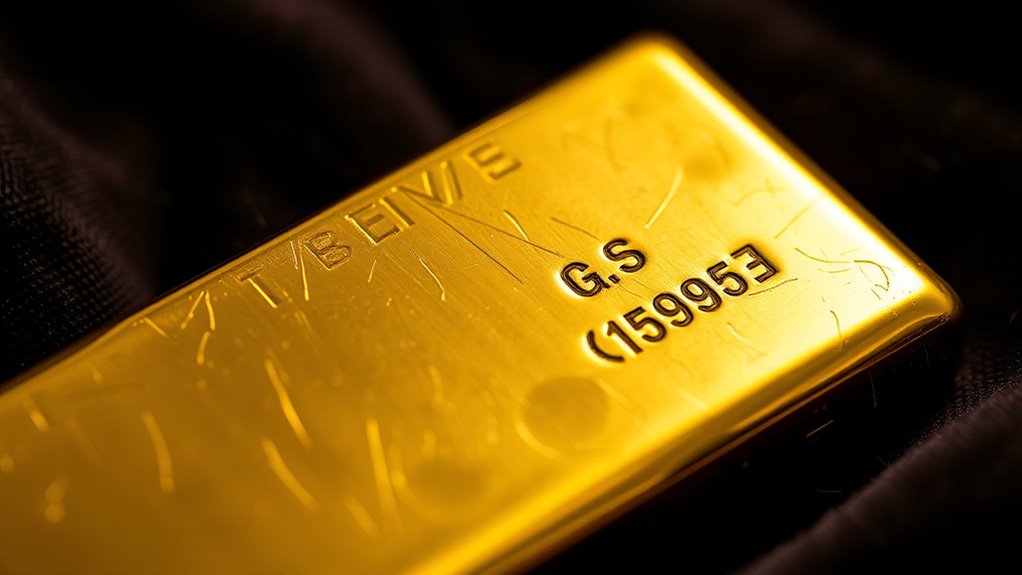
Examining the hallmarks and markings on a gold bar provides a quick and reliable way to verify its authenticity. First, check for the presence of official stamps from reputable refineries, which indicate the manufacturer. Look for markings that specify the purity, such as “999.9” for 24-karat gold, and verify that the weight matches the listed specifications. Authentic bars often display serial numbers that can be cross-checked with certificates or manufacturer records. Ensure the markings are clear, well-engraved, and free of signs of tampering or wear. Be cautious of counterfeit markings or inconsistent fonts, as these can signal a fake. Proper hallmarks serve as a critical initial step toward confirming the gold’s legitimacy before proceeding to other tests. Additionally, examining gold purity markings can help identify genuine bars and distinguish them from fakes.
Conducting Visual and Surface Examination
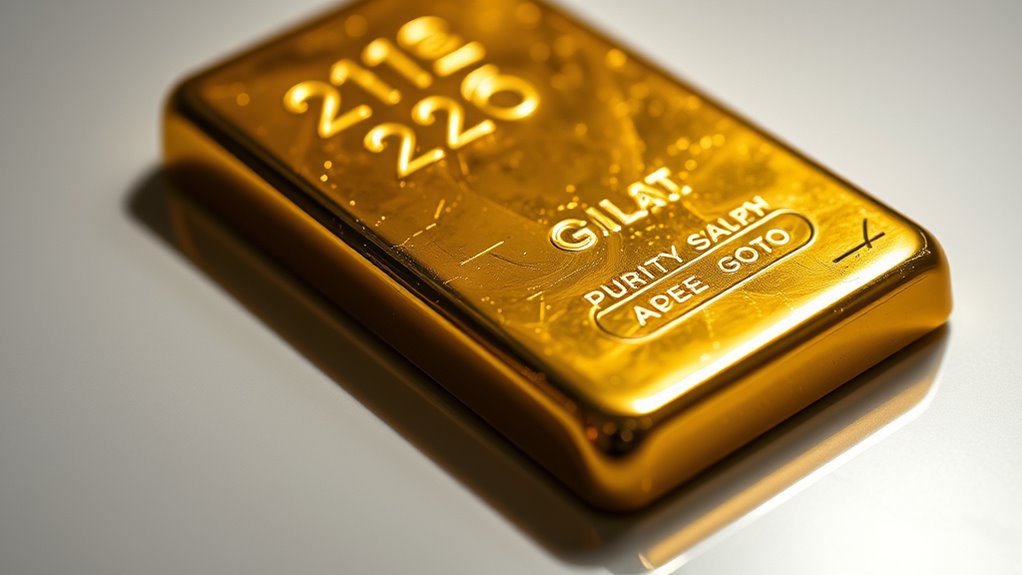
When conducting a visual and surface examination, you want to look for any surface defects or irregularities that could indicate tampering. Check the gold bar’s hallmarks and markings to verify authenticity and make sure they match official standards. Also, observe the color and luster to see if they appear consistent with genuine gold.
Inspect for Surface Defects
Have you ever considered how crucial a careful visual and surface inspection is in verifying a gold bar’s authenticity? You need to look closely for surface defects that may indicate tampering or counterfeiting. Check for scratches, dents, or discoloration, which can signal poor quality or forgery. Examine the uniformity of the surface; irregularities might hide added materials or damage. Look for signs of corrosion or inconsistencies that don’t match genuine gold’s appearance. Be attentive to unusual markings or distortions that could suggest surface tampering. Additionally, filtration methods used during manufacturing can influence the surface finish and should be consistent with authentic gold bars.
Check for Hallmarks and Markings
Checking for hallmarks and markings is a vital step in verifying a gold bar’s authenticity. Look closely at the surface for stamped details that include purity, weight, and refiner’s marks. These markings should be clear, consistent, and well-defined. Counterfeit bars often have smudged or uneven stamps. Use the table below to compare what you should see:
| Authentic Markings | Common Features |
|---|---|
| Purity Stamp | “999.9” or “24K” |
| Refiner’s Mark | Logo or initials of the refiner |
| Serial Number | Unique identification number |
| Weight | Exact weight in grams or ounces |
Ensure all markings match official documentation. Faint, inconsistent, or missing marks indicate potential fraud.
Observe Color and Luster
Examining the color and luster of a gold bar provides immediate visual clues about its authenticity. Genuine gold has a warm, rich yellow hue that remains consistent across its surface. Its luster should be bright and reflective, giving it a smooth, shiny appearance. Look for uneven coloring, dull patches, or tarnishing, which can indicate fake or plated gold. Properly manufactured gold bars maintain a uniform surface free of scratches or discoloration. Surface imperfections or areas that look overly shiny or dull could suggest tampering or counterfeit. By carefully observing these visual cues, you can better assess whether the gold bar is authentic or not. Surface quality is also an important factor to consider, as high-quality gold bars typically have a pristine finish without blemishes.
Density and Weight Testing Procedures
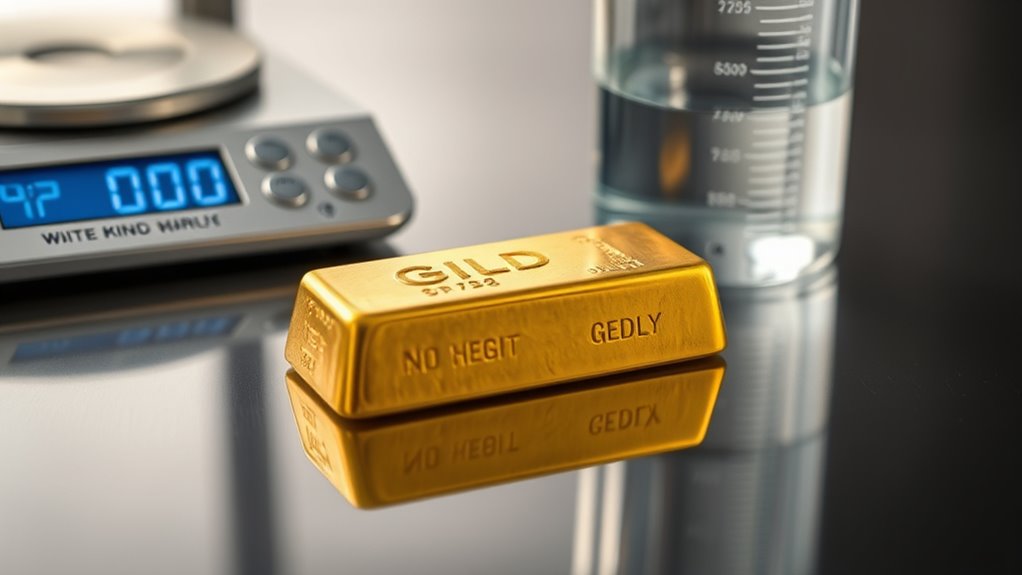
Density and weight testing are essential steps in verifying the authenticity of a gold bar. You’ll start by accurately measuring the bar’s dimensions and weight. Genuine gold bars have specific weights and sizes; any deviation could indicate a counterfeit. To determine density, you divide the mass by the volume, which you find by measuring length, width, and height. Gold’s density is approximately 19.3 g/cm³, so comparing your calculation helps confirm authenticity. Use precise scales for weight and calipers for measurements. Keep in mind, counterfeit bars may have incorrect dimensions or weights. When the density aligns with standard gold values, it’s a strong sign of purity. This straightforward procedure helps identify obvious fakes before moving on to more advanced tests. Additionally, understanding paint sprayer technology can aid in evaluating surface finishes and detect inconsistencies in coating applications that might reveal counterfeit features.
Utilizing Acid-Based Testing Methods
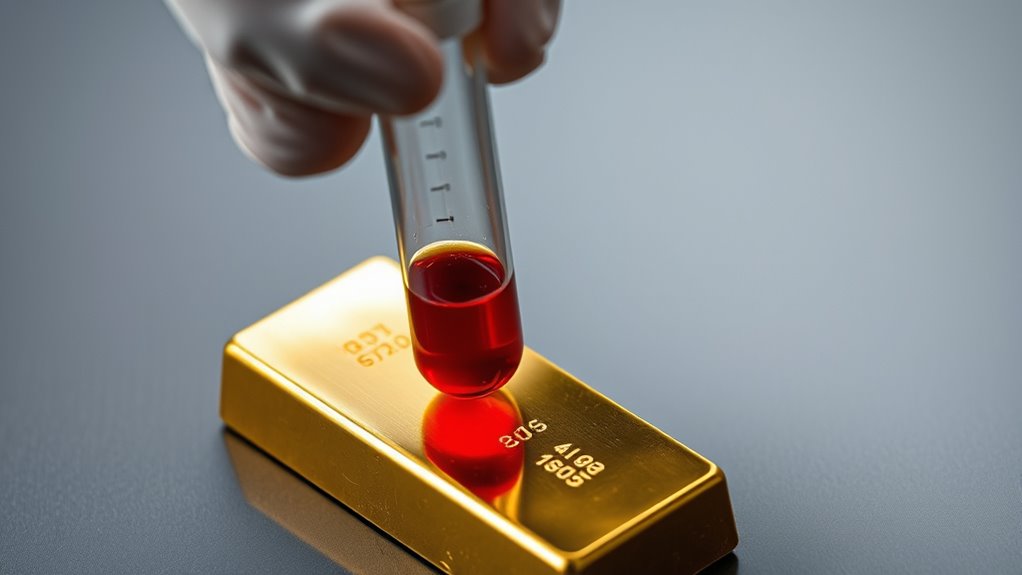
Utilizing acid-based testing methods provides a quick and non-destructive way to verify the purity of a gold bar. You apply a small drop of acid from a test kit onto the gold’s surface, observing the chemical reaction. Genuine gold resists strong acids, especially for 24k purity, while counterfeit metals react differently. This method helps identify the karat and purity level accurately. Additionally, understanding the role of attention in the testing process ensures careful observation of reactions for reliable results.
Acid tests quickly verify gold purity without damage.
- Use touchstone or acid test kits for different gold purities
- Watch for color changes or bubbling indicating a reaction
- Ensure proper safety gear to avoid acid contact
- Compare reactions with known genuine samples to interpret results
This approach offers reliable, immediate insights into your gold’s authenticity without damaging the bar.
Employing X-Ray Fluorescence Analysis

X-Ray Fluorescence analysis lets you examine gold bars without causing any damage, making it a non-destructive method. With portable equipment, you can quickly determine the metal’s precise composition right on site. This technology provides accurate results, giving you confidence in the authenticity of your gold. Additionally, understanding the material composition of the gold can help identify potential impurities or counterfeit items.
Non-Destructive Metal Analysis
Non-destructive metal analysis with X-Ray Fluorescence (XRF) technology allows you to determine the composition of gold bars quickly and accurately without damaging them. This method uses X-rays to excite atoms in the metal, causing them to emit secondary X-rays that reveal their elemental makeup. You can identify not only gold but also other metals present, ensuring the bar’s purity. Portable XRF analyzers let you perform on-site tests, saving time and effort. This technique offers high precision, making it a reliable choice for verification. Additionally, XRF can detect surface contaminants or coatings that might hide counterfeit features. Understanding material composition is essential for accurate assessment and to prevent fraud.
Precise Composition Measurement
Employing X-Ray Fluorescence (XRF) analysis allows you to determine the exact elemental composition of a gold bar with high precision. You simply expose the sample to X-rays, which cause the elements within to emit characteristic secondary X-rays. By analyzing these emissions, you identify and quantify each metal present, including trace elements. This process provides accurate purity measurements without damaging the bar. XRF analysis is quick and can be performed on-site with portable devices, making it ideal for real-time verification. It detects not only gold but also any alloying metals or potential adulterants. This detailed compositional data helps confirm authenticity, ensuring that the gold meets the specified purity standards. Overall, XRF analysis offers a reliable, non-destructive method to verify the true composition of your gold bar. Additionally, understanding the trustworthiness of AI models highlights the importance of precise analytical methods in quality assurance processes.
Portable Testing Equipment
Portable XRF analyzers have revolutionized the way you can verify the authenticity of gold bars on the spot. With these devices, you get immediate, non-destructive analysis of the metal’s composition, helping you confirm purity and detect counterfeits quickly. They work by emitting X-rays that interact with the sample, revealing its elemental makeup with high accuracy. This makes them ideal for field inspections, auctions, or daily transactions. To deepen your understanding, consider these key points:
- Instant results: Get immediate analysis without damaging the gold.
- High accuracy: Precise measurement of purity levels.
- Ease of use: Designed for non-experts to operate confidently.
- Versatility: Can analyze various metals alongside gold for extensive checks.
Using portable XRF analyzers ensures reliable, on-the-spot verification, making your transactions more secure.
Applying Ultrasonic and Non-Destructive Techniques

Applying ultrasonic and non-destructive techniques is essential for verifying the integrity and authenticity of gold bars without causing any damage. These methods reveal internal flaws, foreign insertions, or inconsistencies in composition. Ultrasonic testing uses sound waves to detect internal defects and foreign materials like tungsten. It guarantees the bar’s homogeneity and confirms it’s free from tampering. Here’s a breakdown of the key factors:
| Technique | Purpose | Benefits |
|---|---|---|
| Ultrasonic Testing | Detect internal flaws | Non-invasive, precise |
| Sound Wave Analysis | Check homogeneity | Identifies foreign inserts |
| Internal Defect Detection | Find cracks or voids | Preserves sample integrity |
| Foreign Material Testing | Ensure purity | Rapid and accurate |
| Combined Use | Validate authenticity | Complete assessment |
Using Electronic and Magnetic Verification Tools
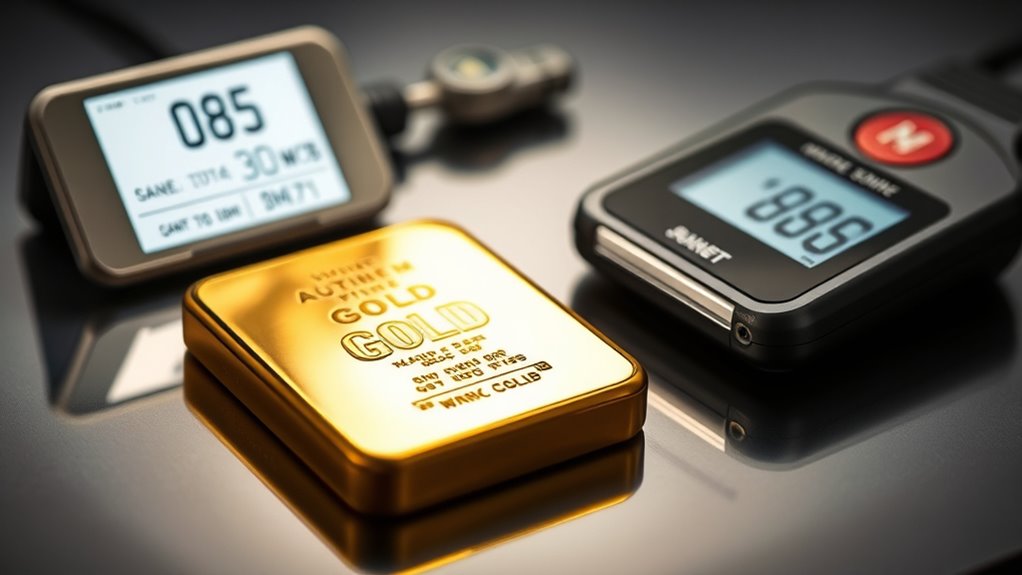
Electronic and magnetic verification tools offer a quick and reliable way to authenticate gold bars without damaging them. These tools leverage gold’s unique electrical and magnetic properties to confirm authenticity efficiently. For instance, the GVS Bullion Tester combines magnetic and density measurements to identify genuine gold. Magnetic tests ensure the bar isn’t counterfeit metal like tungsten, which is often used to mimic gold. Electronic conductivity testers measure how well the metal conducts electricity, providing an estimate of purity. Additionally, magnetic permeability tests assess how the metal responds to magnetic fields, which is specific to gold’s properties. These devices are user-friendly and portable, making them ideal for quick field verification. Utilizing these tools helps you confidently confirm gold authenticity before investing or trading. Understanding gold’s properties enhances the effectiveness of verification methods.
Leveraging Advanced and Specialized Testing Technologies
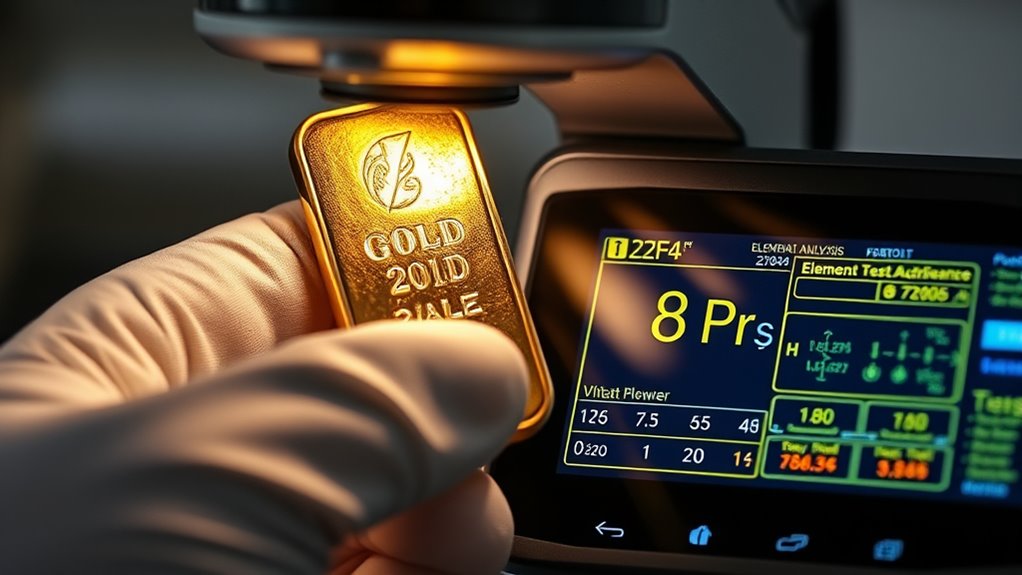
Building on the use of electronic and magnetic tools, leveraging advanced and specialized testing technologies takes gold verification to a higher level of accuracy. Fire assays remain the most precise method, melting the gold to determine its true purity, often required by labs for definitive results. Non-destructive options like GoldScreenSensor devices provide rapid, reliable assessments without damaging the bar. Portable X-ray fluorescence (XRF) analyzers quickly identify elemental composition on-site, confirming authenticity and purity. Ultrasonic testing detects internal defects or foreign insertions, ensuring the bar’s integrity. Combining these techniques offers thorough validation—accuracy, speed, and safety. By utilizing these cutting-edge tools, you can confidently verify the authenticity of your gold bars, minimizing risks associated with counterfeits and ensuring your investment’s value.
Frequently Asked Questions
How Can I Distinguish Genuine Gold From Plated or Vermeil Bars?
To tell if a gold bar is genuine and not plated or vermeil, start by examining its weight, size, and hallmarks. Perform a density test to see if it matches pure gold. Use an acid test to check for purity, ensuring it resists strong acids like 24k gold. Additionally, conduct an ultrasonic or XRF analysis to detect internal defects or foreign metals, confirming the bar’s authenticity.
What Are the Common Signs of Counterfeit Gold Bars During Physical Inspection?
Like spotting a fake relic in a museum, counterfeit gold bars often show telltale signs during physical inspection. You should look for uneven weight, inconsistent markings, or poor craftsmanship. Fake bars may feel too light or too heavy, have blurry or misspelled stamps, or show visible seams from casting. Also, check for discoloration or flaking, which indicates plating or vermeil layers hiding the true base metal.
How Often Should I Verify the Authenticity of My Gold Holdings?
You should verify your gold holdings regularly, ideally every few months or whenever you acquire new pieces. This helps confirm they haven’t been tampered with or deteriorated. If you notice any changes in weight, appearance, or markings, recheck immediately. Also, verify after storage or transportation. Regular testing keeps your investment secure and gives you peace of mind knowing your gold remains authentic and in good condition.
Can a Gold Bar’s Appearance Alone Confirm Its Purity?
A gold bar’s appearance is like a shiny façade that can deceive the eye, but it can’t confirm purity on its own. While hallmark stamps and a flawless look suggest authenticity, counterfeiters often replicate these details. You need to perform or seek out specific tests such as density checks, acid tests, or XRF analysis to truly verify purity. Relying solely on appearance is like judging a book by its cover—unreliable and risky.
Are There Reliable Mobile Apps for Quick Gold Authenticity Checks?
Yes, some reliable mobile apps can help you quickly check gold authenticity. You typically use these apps by taking a photo of the gold bar or entering its details, like weight and hallmarks. They often connect to databases or use augmented reality to compare your item with genuine samples. However, keep in mind these apps aren’t foolproof and should complement physical tests like weight or hallmark verification for best results.
Conclusion
Just like a skilled alchemist seeks to uncover true gold, verifying its purity requires careful testing and keen inspection. By combining traditional methods with advanced technologies, you can confidently distinguish real from counterfeit. Remember, the quest for authenticity mirrors the legendary pursuit of the Philosopher’s Stone—demanding patience, precision, and a discerning eye. Trust your methods, stay vigilant, and you’ll guarantee every gold bar you hold is genuine and pure.