
TL;DR
Mistral’s push for sovereignty isn’t just marketing — it’s about control over AI infrastructure, data, and deployment. Yet, Europe faces hurdles in building a fully independent AI stack, raising the question: is this strategy a gamble or a sign of weakness?
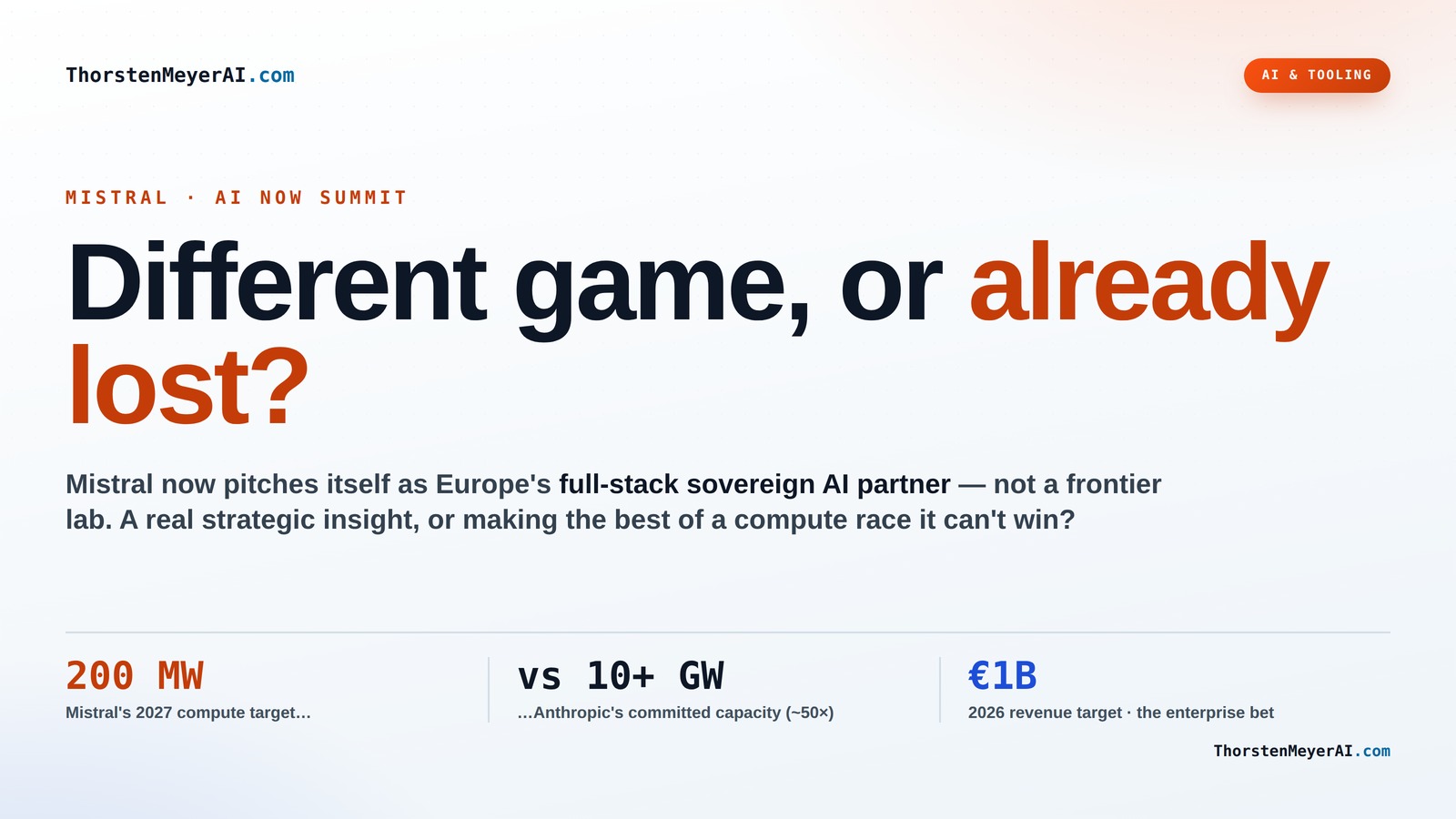
Different game, or already lost?
Mistral now pitches itself as Europe’s full-stack AI provider — compute, models, platform, consultancy — not a frontier-model lab. Is that a real strategic insight, or making the best of a race it can’t win? Both readings fit the same facts.
From model lab to full-stack provider
The clearest signal from the summit wasn’t a model — it was a posture. Heavy on enterprise logos and partnerships (ASML, BNP Paribas, Alexa+), light on new-model announcements. That absence is exactly what skeptics seized on.
Compute
40MW Paris DC + Sweden build · 200MW target by 2027
Models
Open & custom · efficient · you own and run them
Platform
Forge for custom models · Vibe for Work agent
Consultancy
Sales teams, integrators, EU provenance & support
Small & focused, or large & general?
Mistral bets on specialized small models. The claim isn’t that they win a reasoning leaderboard — they don’t. It’s that on the metrics that matter in production agent systems, a purpose-built small model wins. Flip the metric to see the case reverse.
Small specialized vs large general — by what you measure
In token-heavy agentic apps making hundreds of calls, speed/energy/cost compound. Toggle the metric.
Narrow models doing real work
Each is one model doing one thing efficiently — the tangible version of the strategy. Strong on their own terms; the open question is whether the bundle beats a free Chinese open-weight download.
On-prem KYC compliance
Mistral models run inside the bank’s walls for know-your-customer checks. Sensitive financial data never leaves. (BNP was Mistral’s first customer, 2023.)
Voxtral multilingual voice
A focused voice model powering Alexa+ across Europe — speed and efficiency over raw size.
Robostral industrial robotics
Plus a “physics AI” push (via the Emmi acquisition) into aerospace, automotive & semiconductor design and simulation.
Document AI / OCR at scale
Large-scale text extraction — the unglamorous, high-volume enterprise work small models excel at.
The strategy is downstream of the compute gap
Once you see the raw numbers, “why is Mistral behind?” answers itself — and the specialized-small-model strategy starts looking partly like a smart adaptation to a binding constraint, not a pure philosophical choice.
Compute & capital · Mistral vs a frontier leader, this same week
Not a knock — it’s the constraint that forces the efficiency-first, sovereignty-wedge strategy. Adapting intelligently to your position is what good strategy is.
“I want them to win, but I’m worried”
That ambivalence is the most accurate read of where Mistral sits. The enterprise pivot gets read two opposite ways — and both deserve airing.
On-prem, real sales teams, the Koyeb deployment acquisition, EU provenance — exactly what regulated enterprises want, and stickier than consumer mindshare. Targeting €1B revenue in 2026 with 1,000 staff, up from 15 people and one customer in 2023. US closed-API labs structurally can’t match the sovereignty axis.
“Software consultancy with a data center,” not a foundation-model moat. Enterprise B2B is where European startups go when they can’t win consumer or world-scale SaaS. Why pay Mistral on-prem when you could run Qwen free? One paying Le Chat Pro user said the quality gap with frontier labs is now hard to ignore.
Key Takeaways
- Mistral’s sovereignty focus is about controlling the entire AI stack—models, data, and infrastructure—not just developing powerful models.
- Europe’s infrastructure gaps and dependence on U.S. cloud and chip providers threaten its ability to achieve true AI independence in the next few years. Read more about Europe’s sovereignty challenges.
- Open-weight models and small, purpose-built systems are central to Mistral’s strategy, offering control and efficiency over brute-force performance.
- Europe needs rapid infrastructure expansion and regulatory support to turn sovereignty from a slogan into a practical reality.
- Control over deployment and data is more critical for sovereignty than just model size or benchmark scores.
European AI infrastructure hardware
As an affiliate, we earn on qualifying purchases.
As an affiliate, we earn on qualifying purchases.
What Does ‘Sovereign AI’ Really Mean? Control, Data, and Deployment
‘Sovereign AI’ isn’t just a buzzword. For Mistral, it’s about owning the entire AI pipeline—models, data, and infrastructure. This means running models on local servers, keeping sensitive data within national borders, and avoiding dependence on U.S. cloud giants. For example, BNP Paribas uses Mistral models on-prem to comply with strict EU financial regulations, ensuring data never leaves the bank’s control.
This approach contrasts sharply with open AI’s reliance on cloud-based APIs, where data and models are hosted externally. Sovereignty is about making AI a strategic asset, not just a tool. But controlling everything isn’t easy; it requires local compute, legal frameworks, and infrastructure—things Europe is still building.

As an affiliate, we earn on qualifying purchases.
Is Mistral Truly Independent or Just Chasing a Political Dream?
Many wonder if Mistral’s sovereignty claim is more marketing than reality. They emphasize local control, but Europe’s compute capacity limitations are a concern. Mistral’s CEO warned in 2026 that Europe has about two years to build enough local infrastructure to avoid deep dependence on U.S. cloud providers [5].
Without enough local data centers, chips, and energy, full independence remains an uphill battle. Europe’s political goal is clear: reduce reliance on U.S. tech giants. But whether European companies can scale up their own infrastructure fast enough is a different story. It’s a gamble, and the clock is ticking.

As an affiliate, we earn on qualifying purchases.
How Mistral’s Open-Weight Strategy Changes the Game
Mistral’s open-weight models are a key part of its sovereignty pitch. Unlike closed APIs, open weights let customers fine-tune and run models locally, giving them more control. For instance, BNP Paribas uses Mistral’s models on-prem for compliance, trusting the open weights to tweak as needed.
This strategy appeals to regulated industries that need transparency and control. But it also raises questions: can open weights match the performance of giants like GPT-4? And will they be enough to keep Europe competitive? Right now, Mistral’s bet is that smaller, specialized models can outperform larger general-purpose ones in specific tasks.

As an affiliate, we earn on qualifying purchases.
The Power of Small, Focused Models in a Sovereign AI Strategy
Mistral champions small, purpose-built models for efficiency and control. These models aren’t giants like GPT-4, but they excel in specific tasks—OCR for the European Patent Office, multilingual voice for Alexa+, or industrial robotics for ASML. They’re designed to be fast, energy-efficient, and easier to deploy locally.
Imagine a factory in Germany running a tiny, optimized AI to monitor equipment in real-time, without relying on distant servers. That’s the kind of sovereignty Mistral envisions—less dependence, more agility. The tradeoff? They sacrifice broad reasoning ability for speed and precision in narrow tasks.

Are Europe’s AI Ambitions Already Falling Behind?
Europe’s push for AI sovereignty faces a stark reality: infrastructure gaps, lack of chips, and limited investment. Despite strong political will, the continent’s data centers and compute power lag behind the U.S. and China. Learn more about European tech investment. Mistral’s CEO warns that without rapid infrastructure growth, Europe risks being dependent on external tech for decades.
For example, the €1.2 billion data center project in Sweden aims to boost local capacity, but it won’t be operational for years. Meanwhile, U.S. and Chinese giants continue to expand their dominance, making sovereignty a moving target. The question is: can Europe catch up fast enough to turn the tide?

The Real Strategic Play: Control vs. Performance
Mistral’s strategy isn’t about beating the biggest models in benchmark tests. It’s about control—over data, infrastructure, and deployment. This shift means that for Europe, sovereignty might be more about political and operational independence than raw AI power.
For instance, a European bank can run Mistral models on-prem, keep data inside Europe, and avoid U.S. cloud dependence. That’s a different game—less about pushing the biggest numbers and more about strategic autonomy. But that raises a question: is this enough to stay competitive globally, or are they just playing catch-up?

What Would Success Look Like for Mistral in the Next 2 Years?
Success for Mistral isn’t just about model quality. It’s about building a self-sufficient European AI ecosystem—local compute, trusted models, and full control. If they can deploy their models at scale within two years, and convince European regulators and enterprises of their reliability, they gain a strategic edge.
Picture a future where European governments and banks run Mistral models natively, without U.S cloud giants. That’s the vision, but it depends on infrastructure, regulation, and market adoption aligning. The clock’s ticking, and the stakes are high.

Is ‘Sovereign AI’ Just a Political Slogan or a Technical Reality?
Sovereignty sounds powerful, but in practice, it’s a mix of politics and tech. Controlling the model isn’t enough if hardware, chips, and data centers are foreign-owned. Explore strategies for digital independence. Mistral’s approach aims to address this by emphasizing local compute and open weights, but true independence remains elusive without full infrastructure control.
For example, Europe’s dependence on U.S. chips from companies like Nvidia complicates sovereignty. So, while Mistral’s narrative is compelling, the real challenge is building a full-stack ecosystem that can operate without external dependencies.