

Beginners comparing The Simple Path to Wealth by JL Collins with Get Good with Money by Tiffany Aliche are choosing between two different starting points: a focused route to investing and financial independence, or a wider system for organizing money and improving day to day finances. Both use accessible language, but they spend their pages differently. Collins emphasizes spending less than you earn and investing simply; Aliche covers budgeting, debt, savings, credit, insurance, and long term goals in a sequence of practical steps.

Get smart everyday buys delivered free with Prime
- Fast, free delivery on millions of items
- Prime Video, Amazon Music and more included
- Member-only deals all year
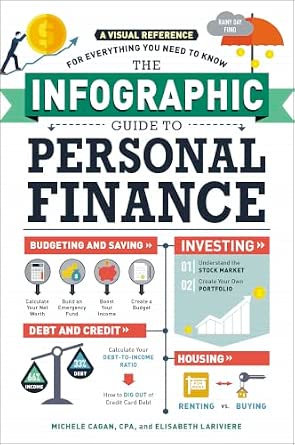
The Infographic Guide to Personal Finance: A Visual Reference for Everything You Need to Know
- ✔ ASIN: 1507204663
- ✔ Series: Infographic Guide
- ✔ Subject: Personal finance

Personal Finance QuickStart Guide: A Beginner’s Guide to Reducing Financial Stress, Building Wealth, and Financial Freedom
- ✔ ASIN: 1945051019
- ✔ Audience stated in subtitle: Beginners
- ✔ Stated focus: Reducing financial stress and building wealth

Personal Finance For Dummies
- ✔ ASIN: 1394207549
- ✔ Subject indicated by title: Personal finance
- ✔ Audience implied by title: Introductory readers
That difference matters if you are not sure what to do first. Readers who already manage bills reasonably well and want a plain explanation of investing may find Collins more direct. Readers juggling debt, uneven savings, credit concerns, or several financial goals may benefit more from Aliche’s broader framework. Neither book replaces personalized advice, and neither is a technical investing manual. The central tradeoff is focus versus coverage: choose the focused book for a clear investing philosophy, and the broader one for a more complete beginner roadmap.
At a Glance
| Criteria | The Simple Path to Wealth by JL Collins | Get Good with Money by Tiffany Aliche | Winner |
|---|---|---|---|
| Scope of guidance | Focused on saving, investing, and financial independence | Broad personal finance system across multiple money areas | B |
| Investing explanation | Clear case for simple, long term stock market investing | Included as part of a wider financial health plan | A |
| Budgeting and cash flow | Discusses spending habits and saving as foundations | Substantial attention to budgeting and financial organization | B |
| Debt and credit | Limited compared with a full debt and credit guide | More extensive treatment of debt management and credit | B |
| Action structure | Strong central philosophy, less of a broad checklist | Organized around a sequence of practical financial steps | B |
| Reading simplicity | Direct, conversational, and deliberately narrow | Accessible but covers more topics and tasks | A |
| Best-fit beginner | Someone ready to start investing and seeking a simple strategy | Someone who needs help building financial foundations across the board | Depends |
The Infographic Guide to Personal Finance: A Visual Reference for Everything You Need to Know
For beginners who want an inviting overview rather than a dense wall of text, The Infographic Guide to Personal Finance has the most clearly defined learning format in this group. Its infographic approach is intended to make personal finance topics easier to scan and revisit, which may suit readers who want a visual reference while they build familiarity. That gives it a more specific advantage than Personal Finance For Dummies, whose supplied description does not tell us how the material is presented. It also differs from Personal Finance QuickStart Guide, which names beginner goals but not a visual or reference format.The limitation is that “everything you need to know” is a broad promise in the title, while the supplied details only confirm a visual reference to personal finance topics. We cannot verify which subjects receive space or how deeply they are explained. A visual guide may also be less satisfying for a reader who wants extended explanations or a step-by-step plan. We would choose it as an accessible first pass and check the contents if we need targeted instruction on a particular financial decision.
Pros:
- Infographic format offers a visual alternative to prose-heavy introductions.
- Described as a reference, making it suited to revisiting topics.
- Covers personal finance topics at a broad level.
- Its format is more clearly specified than those of the other two picks.
Cons:
- The supplied description does not identify specific topics or chapter coverage.
- The depth of explanations and any practical exercises are not stated.
- Visual summaries may not provide the extended guidance some beginners want.
Best for: Beginners who learn well from visual summaries and want a personal finance reference they can scan and revisit.
Not ideal for: Readers seeking confirmed, detailed instructions on a specific subject or a clearly documented step-by-step financial plan.
Bottom line: We’d start here if visual reference is the feature most likely to make personal finance approachable, while checking the contents for any topic-specific needs.
“We’d start here if visual reference is the feature most likely to make personal finance approachable, while checking the contents for any topic-specific needs.”
Personal Finance QuickStart Guide: A Beginner’s Guide to Reducing Financial Stress, Building Wealth, and Financial Freedom
Personal Finance QuickStart Guide speaks directly to newcomers through its subtitle, which names reducing financial stress, building wealth, and financial freedom. That makes its stated orientation more explicit than Personal Finance For Dummies, for which we have only the title, and more goal-focused than The Infographic Guide to Personal Finance, which foregrounds visual reference. For a reader whose main motivation is to feel less overwhelmed and start thinking about long-term financial progress, that framing may be a useful reason to investigate this pick.But a promising subtitle does not tell us how the book gets from motivation to action. The available description gives no confirmed topics, chapter structure, examples, or tools, so we cannot say whether it teaches budgeting, debt management, investing, or another specific planning skill. Compared with the Infographic Guide, its presentation is unknown; compared with the Dummies title, its beginner audience and broad goals are at least explicit. We would shortlist it for its stated focus, then review its contents before relying on it for a particular financial task.
Pros:
- Explicitly aimed at beginners in its subtitle.
- Names reducing financial stress as a central goal.
- Also foregrounds wealth building and financial freedom.
- Its stated goals give it a distinct focus in this comparison.
Cons:
- The supplied description does not explain how the book addresses its stated goals.
- Specific subjects, examples, and exercises are not confirmed.
- Format and depth are not provided, making fit harder to judge.
Best for: Readers new to personal finance who want a book explicitly framed around lowering financial stress and building wealth.
Not ideal for: Buyers who need a verified chapter-by-chapter topic list, hands-on worksheets, or a confirmed learning format before choosing.
Bottom line: We’d consider this for its beginner and goal-focused framing, but would verify the contents before choosing it for specific planning guidance.
“We’d consider this for its beginner and goal-focused framing, but would verify the contents before choosing it for specific planning guidance.”
Personal Finance For Dummies
The title Personal Finance For Dummies positions this book as an accessible entry into a wide subject, which may appeal to readers who want one familiar starting point rather than a niche guide. In this lineup, it sounds broader than Personal Finance QuickStart Guide, whose subtitle emphasizes stress reduction and wealth building, and less format-specific than The Infographic Guide to Personal Finance. That makes it a reasonable candidate for beginners who are still deciding which parts of personal finance they want to learn.Our confidence in the fit is limited by the sparse product information: no description of topics, structure, or format is supplied. We therefore cannot confirm the breadth implied by the title, nor compare its explanations with the visual approach of the Infographic Guide or the stated goals of QuickStart. Readers who need a particular topic covered should inspect the contents rather than assuming coverage from the title. This is the least substantiated choice in the comparison, even if its broad-reference positioning may be appealing.
Pros:
- The title presents it as an introductory personal finance book.
- Its broad framing may suit readers still exploring the subject.
- Offers a contrast to the visual-reference and goal-focused positioning of the other picks.
Cons:
- No product description beyond the title was provided.
- Specific subjects and depth of coverage are unknown.
- Format, exercises, and teaching approach are not stated.
Best for: Beginners looking for a broadly titled personal finance starting point who are willing to check the contents before committing.
Not ideal for: Readers who want a confirmed visual format, clearly stated beginner goals, or verified coverage of a particular planning topic.
Bottom line: We’d keep it on the shortlist as a broad-sounding introduction, but the available information gives us less basis to judge its fit than the other two books.
“We’d keep it on the shortlist as a broad-sounding introduction, but the available information gives us less basis to judge its fit than the other two books.”
As an Amazon Associate we earn from qualifying purchases.
Key Differences
The clearest difference is the job each book is trying to do. The Simple Path to Wealth argues for a restrained approach: spend less than you earn, avoid needless complexity, and invest consistently for the long term. Its narrowness is an advantage for a reader who wants a memorable direction without comparing many products or tactics. It is less useful as a complete household finance handbook if the reader first needs to get current on bills, build a starter emergency fund, or work through debt.
Get Good with Money takes on more of those foundations. Its wider coverage can help a beginner see how budgeting, debt, credit, savings, protection, and future goals fit together. That breadth also means a reader primarily seeking an investing thesis may need to move through material outside the immediate question. The practical choice is not which author offers the universally better book: it is whether the bottleneck is a simple investing plan or an organized financial reset. For many true beginners with several unresolved money tasks, Aliche’s breadth is more useful; for readers who have those basics in hand, Collins is the more efficient read.
Detailed Comparison
Scope of guidance (Get Good with Money by Tiffany Aliche wins — moderate)
Get Good with Money wins by a moderate margin for coverage. It spans more parts of personal finance, which is useful when a beginner needs to understand how debt, savings, credit, and future planning relate. The Simple Path to Wealth intentionally spends more attention on a smaller set of ideas. That focus keeps the message clear, but leaves more practical questions for other sources.
Investing explanation (The Simple Path to Wealth by JL Collins wins — moderate)
The Simple Path to Wealth wins by a moderate margin if the question is how a beginner can invest without making the process complicated. It makes investing and long term wealth building the center of the book. Aliche includes investing within a larger financial plan, so it is a better fit for readers who want investing in context than for those who want the most concentrated explanation.
Budgeting and cash flow (Get Good with Money by Tiffany Aliche wins — moderate)
Get Good with Money wins by a moderate margin for readers who need to see where their money goes and create a workable financial routine. Its broader system gives budgeting and organization more room. Collins still makes saving and controlling spending central to the path he describes, but offers less breadth for someone looking for a full set of budgeting practices.
Debt and credit (Get Good with Money by Tiffany Aliche wins — major)
Get Good with Money wins by a major margin for a beginner whose immediate challenges include debt or credit. These are part of its wider financial health approach, while Collins focuses much more on saving and investing. Someone carrying costly debt should not mistake an investing philosophy for a personalized payoff plan; Aliche is the more relevant starting book of the two.
Action structure (Get Good with Money by Tiffany Aliche wins — moderate)
Get Good with Money has a moderate edge for readers who want a sequence of areas to work through. Its structure helps turn a broad goal such as improving finances into smaller categories of work. Collins offers a strong and memorable guiding philosophy, which can be easier to retain, but a reader may need to translate that philosophy into a detailed plan for their own situation.
Reading simplicity (The Simple Path to Wealth by JL Collins wins — minor)
The Simple Path to Wealth wins by a minor margin for readers who want a short, focused conceptual journey. Its narrower subject makes it easier to keep the main message in view. Aliche’s book remains accessible, but its broader range asks readers to track more categories and steps. Readers who want a fuller guide may see that added scope as a benefit rather than a burden.
Best-fit beginner (major difference)
This is a genuine split. A reader with stable finances who wants a simple investing direction is better served by Collins; a reader who needs to establish financial routines across debt, savings, and credit is better served by Aliche. The gap depends on the beginner’s current problem, so neither book wins for every starting point.
The Simple Path to Wealth by JL Collins: Pros and Cons
Pros:
- Focused explanation of saving and long term investing
- Memorable, simple central philosophy
- Good fit for readers who do not want a complex investing playbook
- Accessible conversational style
Cons:
- Less complete as an all purpose personal finance guide
- Less coverage for readers whose first problems are debt, credit, or budgeting systems
- Its investing philosophy may not answer every personal situation
Get Good with Money by Tiffany Aliche: Pros and Cons
Pros:
- Covers more everyday financial foundations in one book
- Useful attention to budgeting, debt, credit, savings, and goals
- Structured approach can help readers decide what to address next
- Better fit for a reader who wants a wider beginner roadmap
Cons:
- Broader scope may feel less direct for someone focused only on investing
- More topics require more time and attention
- Readers may need separate resources for detailed investment decisions
Who Should Choose What
Choose The Simple Path to Wealth by JL Collins if:
- You have a reasonable handle on bills and debt and want a clear introduction to simple long term investing.
- You prefer one focused philosophy over a wide financial checklist.
- Your main goal is to understand how consistent saving and investing can build wealth over time.
Choose Get Good with Money by Tiffany Aliche if:
- You are starting from scratch and need help organizing multiple areas of personal finance.
- Debt, credit, budgeting, and savings habits are as pressing as investing.
- You prefer a structured set of financial steps over a single central investing argument.
Skip both if: You need individualized advice about taxes, complex investments, bankruptcy, or a high stakes debt decision; use a qualified professional for those circumstances.
Value for Money
Both books offer value as relatively accessible guides, and the better purchase depends on the reader’s unmet need rather than a small difference in price. If you are choosing one book, Get Good with Money can deliver more value to a beginner who would otherwise need several introductions to budgeting, debt, credit, and saving. Its broader coverage may help build a foundation before investing becomes the main task.
Paying for Collins makes more sense when you already have that foundation and specifically want a concentrated investing philosophy. In that case, extra coverage of financial housekeeping may not justify the reading time. If cost is a concern, check a library or used copy; neither book’s value depends on buying additional products. The practical value test is simple: pay for breadth if you have several money systems to improve, and for focus if investing is the question you are ready to answer.
Final Verdict
For a beginner who is still organizing debt, credit, savings, and monthly spending, choose Get Good with Money. It addresses more of the work that often needs to happen before a long term investing strategy can be followed consistently. For a reader whose finances are already stable and who wants a plain, focused route into investing, choose The Simple Path to Wealth.
The biggest deciding factor is your current bottleneck. If you need a broad financial reset, Aliche is the stronger first purchase. If you need an investing framework and value a direct argument over broad coverage, Collins is the better fit. Most complete beginners with several unresolved financial tasks should start with Get Good with Money; readers ready to invest can reasonably skip the wider roadmap and start with Collins.
Frequently Asked Questions
Which book should I read first if I have credit card debt?
Get Good with Money is the more relevant first choice because it gives greater attention to debt and broader financial organization. The right payoff method depends on your balances, rates, and circumstances, so use the book as general education rather than individualized advice.
Which book is better for learning to invest?
The Simple Path to Wealth is the more focused choice for a beginner seeking a simple long term investing philosophy. Get Good with Money places investing inside a broader personal finance plan, which can be useful if you also need to work on foundational money habits.
Are these books suitable for complete beginners?
Yes, though they meet different needs. Aliche’s broader framework suits someone who wants help with several parts of personal finance. Collins suits someone who can follow a focused discussion of saving, investing, and long term wealth building.
Do I need to read both books?
No. Choose the one that matches the problem you need to solve now. Read both only if you want a broad financial foundation followed by a concentrated investing perspective; they are complementary, but neither is a required companion to the other.